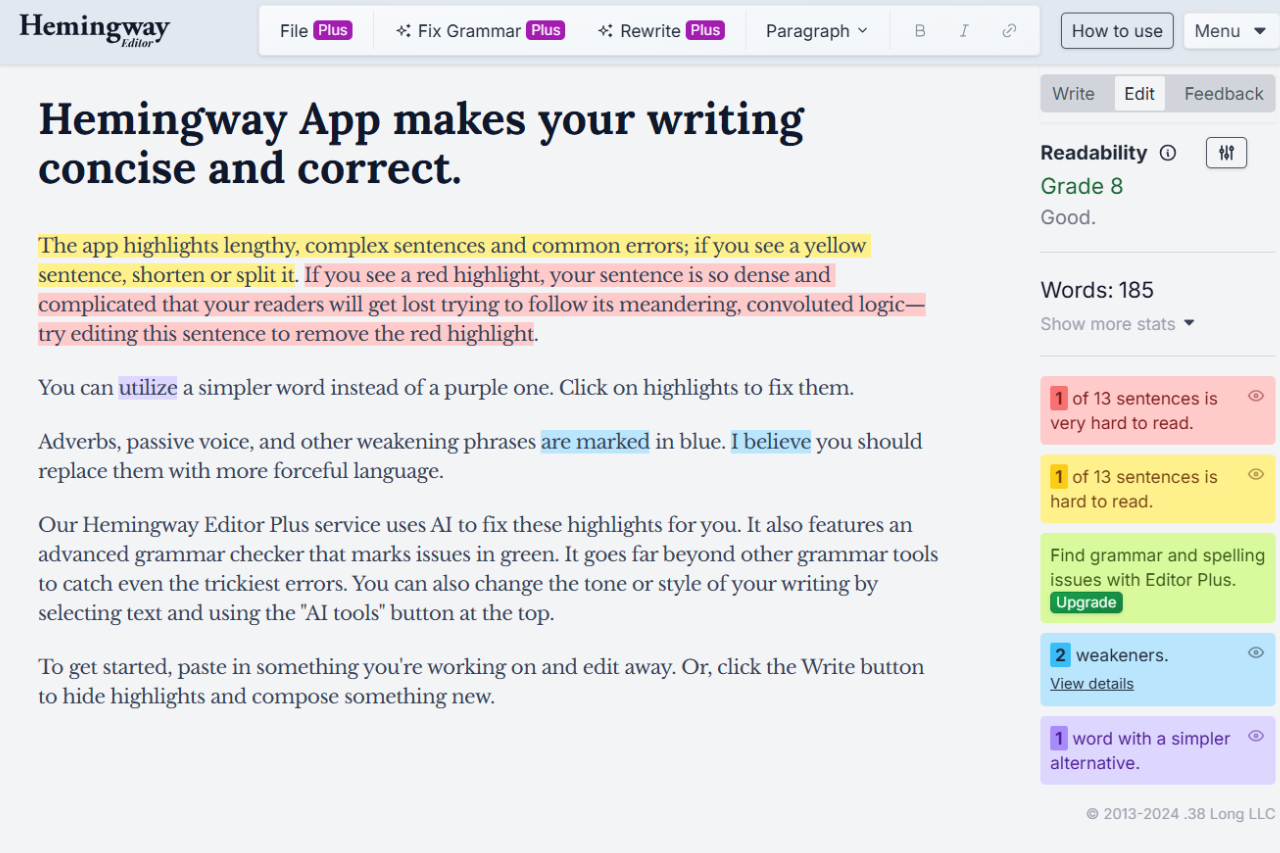
Hemingway Editor is an intuitive, streamlined tool designed to enhance writing clarity and simplicity. Ideal for both amateur and professional writers, it focuses on improving readability by highlighting dense and complex sentences, passive voice, adverbs, and more. While it doesn’t include the grammatical checking found in some competitors, its ability to teach concise writing through real-time feedback makes it an invaluable tool for those looking to hone a clear, impactful writing style.
✅ Pros & ❌ Cons
Pros
Real-Time Feedback: Immediate suggestions to simplify and strengthen writing.
Ease of Use: Simple, user-friendly interface with no learning curve.
Readability Focus: Specific emphasis on sentence structure and readability.
Affordability: One-time purchase for the desktop version.
Offline Access: Desktop version works without an internet connection.
Cons
Limited Grammar Checking: Does not offer comprehensive grammar checks.
No Thesaurus or Synonyms: Lacks tools for vocabulary enhancement.
No Collaboration Features: Does not support real-time collaborative writing.
No Cloud Integration: Limited support for cloud storage or syncing.
Platform Limitation: Desktop version only available for Mac and Windows.
📖 About
Hemingway Editor is a dedicated writing enhancement tool that encourages succinct and forceful prose. Unlike general word processors, Hemingway provides immediate visual feedback on areas of potential improvement, helping writers understand and reduce the complexity of their sentences, making the text bold and clear.
🗓️ How It Works
Open the Editor: Access Hemingway Editor online or through the desktop app.
Enter Your Text: Paste or type directly into the editor.
Analyze and Edit: Follow the color-coded suggestions to improve sentences.
Enhance Readability: Adjust your text based on the readability grade provided.
Export or Publish: Export your edited work to various formats or publish directly online.
💲 Pricing Overview
Hemingway Editor offers a free online version and a paid desktop version, priced at a one-time fee of $19.99, which includes all future updates.
🥊 Competition
Feature
Hemingway Editor
Grammarly
Grammar Checking
Basic
Advanced, with contextual spelling checks
Style Feedback
Focus on readability and sentence structure
Broader feedback on clarity and engagement
Usage
No account needed, offline access available
Requires login, primarily online
Price
Free online, $19.99 for desktop
Free basic version, premium subscriptions
Platform Compatibility
Web, Windows, macOS
Web, Windows, macOS, browser extensions
📌 Conclusion
Hemingway Editor is perfect for writers focused on enhancing the clarity and impact of their text. While it may lack some of the advanced grammatical tools of its competitors, its specific focus on improving readability through simplicity makes it a standout choice for anyone looking to cut the fluff from their writing.
Manuskript is an open-source writing tool designed for authors who need help organizing their thoughts and manuscripts. It offers a straightforward, distraction-free environment ideal for structuring complex projects such as novels and research papers. With features like the snowflake method for plotting, index card corkboard, and frequency analyzer, Manuskript is particularly well-suited for writers who appreciate thorough planning and detailed organization in their creative process. While its interface might not be as polished as some proprietary software, its commitment to open-source principles offers a highly customizable experience for technically inclined users.
✅ Pros & ❌ Cons
Pros
Open Source: Free to use and modify.
Plot Development Tools: Includes the snowflake method and outliner.
Customizable: Flexible for users comfortable with tweaking software.
Multi-Platform Support: Available on Windows, macOS, and Linux.
Cons
Limited File Compatibility: May not export directly to standard formats like DOCX without additional steps.
User Interface: Less intuitive and visually appealing than commercial alternatives.
Technical Support: Mostly community-driven, which can be less reliable than dedicated support teams.
Performance: Can be buggy and less polished, typical for open-source projects.
Feature Integration: Lacks seamless integration of advanced publishing tools.
📖 About
Manuskript is a versatile tool for writers that combines text editing with project management capabilities. It helps users organize plots, characters, and settings with ease, making it ideal for both fiction and non-fiction projects. The software is developed by a community of contributors focused on enhancing writers’ productivity without the overhead of commercial software.
🗓️ How It Works
Installation: Download from the official GitHub repository or website.
Setup Your Project: Start with high-level structure using the snowflake method or traditional outlining.
Write and Edit: Switch between outliner, distraction-free mode, and normal text editing.
Organize Research: Keep track of research, characters, and plot elements in one place.
Export Your Manuscript: Compile your manuscript into standard formats for submission or self-publishing.
💲 Pricing Overview
Manuskript is completely free. Being open-source, it relies on community support and contributions rather than a pricing model.
🥊 Competition
Feature
Manuskript
Scrivener
Ulysses
yWriter
Price
Free
Paid
Paid subscription
Free
Open Source
Yes
No
No
No
Interface
Basic and less polished
Sleek and highly polished
Polished, Markdown-based
Plain and utilitarian
Plotting Tools
Snowflake method, index cards
Corkboard, advanced scrivening
None built in
Scene and chapter cards
Platform
Windows, macOS, Linux
Windows, macOS, iOS
macOS and iOS only
Windows, plus mobile apps
Support
Community-driven
Professional, dedicated support
Professional, dedicated support
Developer and community forum
Customizability
Highly customizable
Limited customization options
Limited, opinionated design
Moderate, with export options
yWriter is the other free option here, built around scene and chapter cards but Windows-first, while Ulysses is a paid, Apple-only Markdown app. Manuskript is the only one of the four that is both free and open source, and it runs on Windows, macOS, and Linux.
A first project in Manuskript, from premise to export
Here is how a first novel usually takes shape in Manuskript. You open a new project and start in the Outline view, where the story is still a one-line premise. You expand that line into a few sentences, then into a paragraph per chapter, working down the way the Snowflake method suggests. Nothing is locked, so a chapter that grows too big can be split in a couple of clicks.
Once the shape holds, you move to the index cards. Each scene gets a card with a short summary, a point-of-view character, and a status label such as draft or revised. Dragging the cards into a new order rearranges the book without touching a word of the prose, which makes the messy middle far less daunting to work through.
Character and world notes sit in their own tabs, so a detail you invented in chapter two stays one click away in chapter twenty. When the draft is ready you compile it. Choose the chapters you want, pick plain text, Markdown, or a rough EPUB, and export. The project itself stays in an open format on your own disk, so the manuscript is never trapped inside the app.
🎬 Scriptwriting counterpart
Manuskript shines on prose. For writers who also work in screenplay or teleplay format, pairing it with KIT Scenarist covers the script side with built-in beat cards, a research module, and .fdx export. KIT Scenarist is free and open-source, same philosophy as Manuskript, so the workflow stays consistent across mediums.
📌 Conclusion
Manuskript is an excellent choice for writers looking for a non-commercial, highly customizable writing tool. It supports a wide range of creative writing needs from plotting to drafting. While it may lack the polished feel of paid software like Scrivener, its commitment to open-source development ensures that it remains accessible and adaptable to all writers.
Yes. Manuskript is open source under the GPL, with no paid tier, no subscription, and no account to create. You download it, install it, and keep every feature. That is the main reason writers reach for it instead of Scrivener or Ulysses, which both charge for the app or a recurring plan.
What platforms does it run on?
It runs on Windows, macOS, and Linux. Because the project is community maintained, the cleanest install on macOS and Linux is usually the build from the project’s releases page rather than an app store, and Linux users can often install it straight from their distribution’s package manager.
How does the outline-first workflow actually work?
Manuskript is built around an outliner. You draft the structure as a tree of folders and scenes, attach a one-line summary to each, and write the prose underneath. The outline, the character sheets, and the plot view all read from that same tree, so reordering a scene moves everything tied to it. Writers coming from a blank word processor tend to notice the difference most on a second draft, when the structure is what needs to change.
Can I get my manuscript out of it?
Exports cover the formats most submissions need, including plain text, HTML, ODT, and DOCX through the open document pipeline, plus ebook output for a rough EPUB. Your work also lives in an open project format on your own disk, so nothing is locked behind a vendor. For writers who want a free tool that owns the whole drafting stage offline, that combination of outliner, character tracking, and open export is the case for Manuskript.
Method over blank slate: Manuskript is a free, open-source outliner you drive yourself. If you would rather be walked from premise to finished draft, The Book Incubator teaches the path as you write.
Related open-source tool: Manuskript builds the novel outward from an outline. If you would rather draft first and keep research, characters and notes alongside the text as you go, Quoll Writer is the other free open-source desktop option worth a look.
Related read: Manuskript’s own weak spot is polish: a basic interface and the occasional bug that comes with community-driven development. Bibisco is the other open-source novel planner, also GPL, with a funded Supporters Edition paying for the finish Manuskript’s volunteers cannot.
Related read: Manuskript’s minimalist writing mode is one part of a much larger outliner, with the snowflake method and plot tools around it. If the outlining is more than the book needs, FocusWriter is the drafting screen on its own, also open source, on Windows and Linux.
Reedsy is a comprehensive platform designed for independent authors and publishers looking to professionalize their book projects. Offering access to a network of top-tier industry professionals from editors and designers to marketers, Reedsy facilitates every aspect of the book creation process. Its intuitive marketplace environment, combined with collaborative tools, positions it uniquely within the self-publishing space. Although it may require a budget that some indie authors find steep, the quality of services and resources justifies the investment, making it a prime choice for those serious about quality and marketability.
✅ Pros & ❌ Cons
Pros
Wide Range of Services: From editing to cover design, all available in one platform.
High-Quality Professionals: Vetted experts with industry experience.
Project Management Tools: Simplifies collaboration and project tracking.
Free Learning Resources: Extensive guides and courses on publishing.
Global Reach: No geographical restrictions on service provision.
Cons
Cost: Premium services may be expensive for some indie authors.
No Direct Publishing: Focuses on preparation, not the act of publishing itself.
Limited Instant Booking: Most services require negotiation and proposals.
No Real-Time Collaboration on Documents: Communication mainly via messages.
📖 About
Reedsy provides a marketplace that connects authors with publishing professionals to collaborate on all phases of book production and marketing. It aims to streamline the often-complicated self-publishing process, making it accessible and manageable through technology and a network of skilled professionals.
🗓️ How It Works
Sign Up and Create a Profile: Authors join Reedsy to outline their project needs.
Select Services: Users can browse and select from various services like editorial, design, and marketing.
Receive Quotes: After sending a brief, authors receive quotes from professionals.
Collaborate and Manage: Use Reedsy’s project management tools to collaborate and keep track of progress.
Publish and Market: With the project complete, authors move on to publish and market their books with the industry’s best practices.
💲 Pricing Overview
Reedsy operates on a quote-based system where professionals set their rates, and authors can compare different proposals. There is no subscription or fee to join; instead, Reedsy takes a commission from the freelancers’ earnings.
🥊 Competition
Feature
Reedsy
Publisher Rocket
Service Scope
Full-service, from editing to marketing
Focused on marketing and keyword research
Professional Network
Extensive, global reach
N/A
Pricing Model
Quote-based, varied
One-time fee for software
Tool Integration
Project management and collaboration
Amazon keyword optimization
Target User
Independent authors, small publishers
Authors looking to boost Amazon sales
📌 Conclusion
Reedsy is an essential platform for any author serious about producing a professional-quality book. While it comes with a price tag, the investment in Reedsy’s network of professionals ensures a higher likelihood of publishing success. For those looking to maximize their book’s potential from manuscript to market, Reedsy offers the tools and expertise required to make it happen.
Before the professionals get involved: Reedsy’s marketplace assumes you already have a manuscript to hand an editor. If finishing one is the part that keeps stalling, The Book Incubator is a 12-month coaching program for novelists built on weekly deadlines and peer review groups. Our review covers what it costs and who it suits.
Storyist is a comprehensive writing application that caters specifically to novelists and screenwriters. With its robust feature set that includes rich text editing, storyboard support, and manuscript formatting, Storyist offers a specialized environment for crafting detailed narratives. This Mac and iOS exclusive tool enhances productivity with its intuitive interface and extensive customization options. While it may not have the cross-platform availability of some competitors, its deep integration with Apple’s ecosystem makes it a strong choice for users of those devices.
✅ Pros & ❌ Cons
Pros
Rich Text Editor: Supports comments, images, headers, footers, and stylesheets.
Storyboarding Tools: Helps in organizing scenes and chapters visually.
Full Manuscript Formatting: Adheres to industry standards for both screenwriting and novel writing.
Mobile Compatibility: Fully functional on both macOS and iOS devices.
Cloud Sync: Offers synchronization across devices via iCloud.
Cons
Limited Platform Support: Available only for Mac and iOS users.
No Real-Time Collaboration: Does not support collaborative writing features.
Pricier Option: Higher cost relative to some alternatives.
Complex Interface: Can be overwhelming for new users.
Limited Third-Party Integration: Minimal support for external cloud services besides iCloud.
📖 About
Storyist is a powerful tool designed for writers who need more than just a word processor. Unlike general-purpose writing applications, Storyist blends a clean writing interface with powerful planning tools, making it ideal for producing submission-ready manuscripts and screenplays.
🗓️ How It Works
Download and Install: Available directly from the Mac App Store or Storyist website.
Setup Your Project: Choose from templates for novels, scripts, and more.
Write and Organize: Use the text editor and storyboarding features to draft and arrange your narrative.
Format Your Manuscript: Apply industry-standard formatting for submission.
Sync and Share: Save your work to iCloud for backup or to continue on another device.
💲 Pricing Overview
Storyist offers a one-time purchase for the desktop version and a separate purchase for the iOS app. Prices are set higher than some alternatives but reflect the specialized tools and features it provides.
Here are the details from the Storyist Store:
Storyist 4 for macOS: Priced at $59.00, requires macOS 10.14 Mojave or later. Available for purchase directly from the Storyist website or via the Mac App Store. Paddle.com processes the orders as the merchant of record.
Storyist 4 for iOS: Priced at $19.00, requires iOS 14 or later. Also available through the App Store.
Both versions offer upgrade pricing for existing users. For any order-related queries, customers are encouraged to contact Storyist support.
For more detailed information, you can visit Storyist Store.
🥊 Competition
Feature
Storyist
Scrivener
Platform Compatibility
macOS, iOS only
Windows, macOS, iOS
User Interface
Structured around manuscript and screenplay formatting
More flexible, customizable interface
Tools
Storyboarding, rich text editing, cloud sync
Extensive corkboard, outlining tools
Collaboration
None
Limited collaboration
Pricing Model
One-time purchase
One-time purchase with different pricing per platform
📌 Conclusion
Storyist stands out for its focused feature set designed specifically for serious novelists and screenwriters. It excels in providing a tailored environment that supports the creative process from conception to completion. While its platform limitations may deter some, for Mac and iOS users, it offers a robust, all-in-one solution to navigate the complexities of professional writing.
Storyist: Craft Your Story Beautifully, Wherever Inspiration Strikes
Cross-platform free counterpart: Storyist is a polished Mac and iOS app with a price tag to match. Writers on Windows or Linux, or anyone who needs a free tool with the same character-sheet and plot-graph features, end up on Manuskript.
Cross-platform pick: Storyist is Apple-only. If you also work on Windows or Linux, Kit Scenarist is the free, open-source toolkit that runs across all three and handles both the script and the scene outline.
Free alternative: Storyist pairs manuscript writing with story-development tools on Apple devices. For a free, cross-platform option focused on quiet drafting, Quoll Writer covers the same novelist workflow without the price or the Apple lock-in.
Related read: Storyist is Mac and iOS only, which settles the question for anyone on Windows or Linux. Bibisco covers all three desktop platforms with one license, and its optional Everywhere subscription adds the phone and tablet apps that Storyist gets from iCloud.
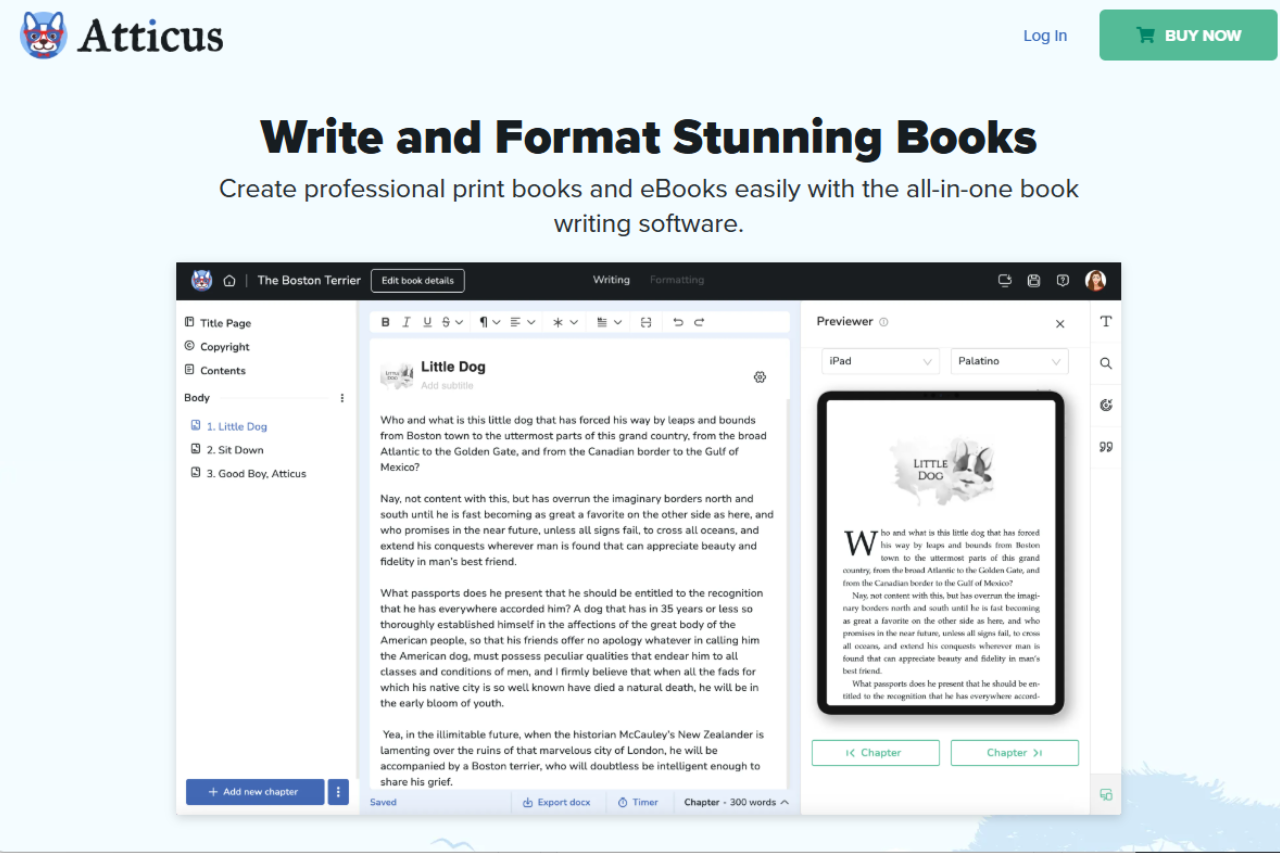
Atticus is a robust book writing software that caters to both amateur and professional writers looking to streamline the creation of print books and eBooks. With its platform-independent functionality, Atticus offers a flexible solution that works on Windows, Mac, Linux, and Chrome. It integrates the entire book creation process from writing to formatting and publishing, making it an indispensable tool for writers who value efficiency and simplicity. While it lacks some of the more complex literary tools provided by its competitors, its user-friendly interface and all-in-one capability make it a compelling choice for authors who need a straightforward, reliable writing environment.
✅ Pros & ❌ Cons
Pros
Cross-Platform Compatibility: Works across multiple operating systems.
User-Friendly Interface: Intuitive design that simplifies the writing process.
Integrated Publishing Tools: Allows users to write, format, and publish all within the same software.
Cloud-Based: Ensures work is saved and accessible from any device.
Affordable Pricing: Competitive one-time pricing with a 30-day satisfaction guarantee.
Cons
Limited Advanced Literary Tools: Does not offer as extensive tools as some competitors for complex literary projects.
No Real-Time Collaboration: Lacks features for live collaboration with other authors or editors.
Performance Issues: Can experience slowdowns with larger files.
📖 About
Atticus is designed to provide a seamless book writing experience by combining writing, formatting, and publishing tools into a single software solution. It supports various text formats and is tailored to handle everything from novel writing to complex non-fiction projects efficiently.
🗓️ How It Works
Sign In to get started and Open Atticus: Accessible through any modern web browser or download the desktop application.
Start a New Project: Set up your book with customizable templates and settings.
Write and Format: Utilize the integrated tools to write and format your text directly in Atticus.
Review and Edit: Apply finishing touches with built-in editing and proofreading tools.
Publish: Export your finished book to multiple formats ready for printing or digital distribution.
💲 Pricing Overview
Atticus offers a one-time purchase price of $147, which includes all features with no additional subscriptions or hidden fees. This pricing is competitive within the market, especially considering the all-in-one functionality it provides.
🥊 Competition
Feature
Atticus
Scrivener
Platform Compatibility
Windows, Mac, Linux, Chrome
Mac, Windows, iOS
User Interface
Intuitive and easy to navigate
Complex with a steep learning curve
Literary Tools
Basic to intermediate
Extensive and advanced
Collaboration
Not supported
Limited support
Pricing
One-time fee with a 30-day guarantee
One-time fee varies by platform
Publishing Integration
Direct publishing tools
Requires additional steps for formatting
📌 Conclusion
Atticus stands out in the realm of writing software by offering a simplified, all-in-one solution for authors who need an efficient pathway from concept to publication. It may not have the depth of literary tools that some competitors offer, but its ease of use, affordability, and robust publishing features make it a valuable asset for writers focused on productivity and simplicity.
Related read: Atticus starts working once the manuscript exists, and formatting is the easy half. For the year before that, The Book Incubator is novelist Mary Adkins’ coaching program for writers who want a publishable draft by year-end. Our review covers the fee, the application, and the complaints past members raise.
Earlier in the process: Atticus is a one-time purchase that pays off at the formatting stage, where a finished manuscript becomes print and ebook files. For the drafting that comes first, Quoll Writer is a free desktop workspace, though check its export notes if you need EPUB.
The other way to pay: Atticus is $147 once and earns its keep at the formatting stage, after the draft exists. If you would rather pay monthly and sell the finished book inside the same app, Chapterly covers drafting, formatting and a reader marketplace for $9.99 a month plus 10% of what you earn.
The Book Incubator does not list a public price; you get the cost after a short application. It is a 12-month coaching program for novelists, and past cohorts report a fee in the low four figures, often cited around $1,500 for the full track. Confirm the current price and any payment plans through the application on the official site.
The Book Incubator is a 12-month structured program for fiction writers who want a publishable manuscript by year-end. Reviews from past members describe it as accountability-heavy: weekly deadlines, peer review groups, and direct feedback from founder Mary Adkins. Critics note that the price ($1,500+) is steep for self-directed writers.
Last updated 31 July 2026. Founder attribution and pricing corrected. The Book Incubator is Mary Adkins’ novel-writing program. The Author Incubator, run by Angela Lauria, is a separate non-fiction program that is often confused with it.
The Book Incubator is Mary Adkins’ year-long coaching program for novelists who want to finish a publishable manuscript. Adkins is a novelist published by HarperCollins and has run the program since 2021. The price is not posted publicly; you get a figure after a short application, and past cohorts report a fee in the low four figures. It suits writers who keep stalling on a draft and can commit to a full year. It is a poor fit if you want a finished book in weeks, or a cheap self-paced course.
🏆 Our Verdict
The Book Incubator presents a unique, immersive program specifically designed for serious writers aiming to refine and complete their novels. With a hands-on, mentor-driven approach that combines rigorous workshops with personalized feedback, The Book Incubator excels at transforming rough manuscripts into polished, publishable works. While it may not offer the wide platform compatibility of software-based solutions, its in-depth, personalized coaching and community support make it invaluable for writers committed to making significant progress on their novels.
✅ Pros & ❌ Cons
Pros
Personalized Feedback: Direct mentorship from experienced authors and editors.
Comprehensive Curriculum: Covers all stages from drafting to revision.
Community Support: Robust community engagement that fosters peer learning.
Goal-Oriented: Structured to help authors complete a manuscript.
Exclusive Workshops: Access to workshops that focus on both craft and the practical aspects of publishing.
Cons
High Cost: More expensive compared to self-guided writing tools.
Limited Platform Flexibility: Primarily in-person or Zoom-based, without a dedicated writing app.
Geographical Limitations: Best suited for those who can attend sessions in specific locations or online at set times.
Intensive Commitment: Requires a significant time investment, which may be challenging for some writers.
Niche Focus: Primarily aimed at novel writers, less suited for other types of writers.
📖 About
The Book Incubator is more than a writing course; it’s a comprehensive program designed to take a novel from concept to completion. Founded by a novelist frustrated by traditional solitary writing processes, it offers a structured, community-focused approach that provides the tools, knowledge, and support necessary for writing and revising a publishable novel.
🗓️ How It Works
Enrollment and Orientation: Writers join the program and are oriented on goals and processes.
Regular Workshops and Meetings: Participants engage in scheduled workshops focusing on different aspects of novel writing.
Drafting and Feedback: Writers work on their manuscripts, receiving ongoing feedback from mentors.
Peer Reviews and Revisions: Manuscripts are critiqued by peers and revised based on feedback.
Final Review and Preparation for Publishing: The final draft is polished for submission to publishers or agents.
💲 Pricing Overview
The specific pricing details for The Book Incubator are not publicly displayed on their website. They invite potential participants to fill out a form to receive more information, including details about pricing and payment plans. This approach suggests a tailored experience, possibly with varying pricing structures depending on the level of engagement and resources provided. For exact pricing, you would need to contact them directly through their website: The Book Incubator.
🥊 Competition
Feature
The Book Incubator
iA Writer
Platform
In-person/Online (Zoom)
Cross-platform (iOS, Android, Mac, Windows)
Focus
Novel writing and publishing
Distraction-free writing environment
Feedback
Personalized, in-depth feedback
Limited to syntactical suggestions
Community
Strong, with peer and mentor support
None
Pricing
High, with comprehensive support
One-time or subscription-based pricing for app
📌 Conclusion
The Book Incubator is an exceptional program for writers who are serious about completing and polishing a novel with the aim of publication. It stands out by providing a structured, supportive community that guides writers through the complex process of novel writing. While it requires a significant investment of both time and money, the potential returns— a finished, market-ready manuscript—are well worth the commitment.
The Book Incubator: From First Draft to Published Book
The program has run since 2021 under founder Mary Adkins, a novelist whose books have been published by HarperCollins. Its site names the instructors, lists alumni testimonials, and sells through an application rather than an open checkout. Before you go looking for reviews, note that The Book Incubator is not The Author Incubator. That is a separate non-fiction program run by Angela Lauria, and reviews of the two get mixed together.
Book Incubator pricing and refund policy
The Book Incubator does not publish a price. You get a figure after a short application, and past cohorts report a fee in the low four figures for the full 12-month track. Refund terms are not posted publicly either. Ask for them in writing, along with the payment schedule and what happens if you leave mid-cohort, before you pay a deposit.
Book Incubator vs. self-publishing courses
The Book Incubator focuses on completing a first-draft manuscript. Self-publishing courses, like Self-Publishing School or 20Booksto50K Academy, focus on what happens after the manuscript exists: cover design, ad spend, KDP setup, and launch lists. Picking between them comes down to where you are in the process. Pre-draft writers usually need the Incubator. Finished-manuscript writers need a self-publishing course.
The Book Incubator reviews: is it worth it for novelists?
Most people searching for The Book Incubator want to know one thing before they commit: does the structured, course-style approach actually help finish a novel, or does it get in the way? Here is an honest read on where it fits.
What writers tend to like
The draw is the guided structure. Instead of a blank page, you get a method that walks a manuscript from premise to finished draft, with the writing tool and the teaching wrapped together. Writers who stall on planning, or who have started several novels and finished none, are the ones who report the biggest difference.
Where it is not the right fit
If you already have a process that works and just want a clean editor, the method can feel like extra scaffolding. Plotters with a detailed outline, or anyone who only needs distraction-free drafting, will get there faster with a lighter tool.
How to decide
Try it on a project you have struggled to finish, not one that is already flowing. The structure earns its keep when momentum is the problem, not the typing.
Is The Book Incubator right for you?
The Book Incubator is a year-long, high-touch coaching program, and the commitment reflects that. It fits some writers well and is the wrong tool for others. Here is a quick gut check before you apply.
It is likely a good fit if:
You have a book you keep stalling on and want structure plus real accountability to finally finish it.
You can commit to a full year and the coaching investment is within reach.
You want a done-with-you process with feedback, not a self-paced course you work through alone.
It is probably not a fit if:
You mainly want templates or a low-cost self-study course.
You need a finished manuscript in a few weeks rather than over a year.
You are weighing it purely on price against a cheap online course. It is a different category, so that comparison will always look unfavourable.
If the structure and the year-long commitment match where you are, it can be worth it. If you want a low-cost, self-paced option, a standard writing course will serve you better.
iA Writer is designed to enhance focus and clarity for writers across various platforms. Its clean, distraction-free interface and full Markdown support make it a favorite among writers who prefer simplicity and efficiency in their writing tools. While it offers fewer organizational tools compared to some competitors, its focus on writing without distractions makes it highly effective for those dedicated to the craft. For writers looking for a straightforward writing tool without the complexities of broader project management, iA Writer proves to be an excellent choice.
✅ Pros & ❌ Cons
Pros
Distraction-Free Interface: Offers a minimalistic design that reduces clutter.
Focus Mode: Blurs out all text except the current sentence or paragraph to enhance concentration.
Markdown Support: Full support for Markdown with live preview.
Cross-Platform Availability: Available on macOS, iOS, Windows, and Android.
Synchronization: Seamless cloud integration with iCloud and Dropbox.
Cons
Limited Text Formatting: Primarily focuses on plain text and Markdown, limiting rich text formatting.
No In-App Collaboration: Lacks real-time collaborative writing features.
Limited Organizational Tools: Not ideal for managing large projects or complex writing structures.
Premium Price: Requires a purchase after a trial period.
📖 About
iA Writer is renowned for its minimalist design that keeps the user’s focus strictly on writing. The app supports Markdown, a plain text formatting system that is intuitive and easy to learn, with built-in templates for different types of content. It’s designed to work seamlessly across all devices, keeping your documents accessible and synchronized wherever you go.
🗓️ How It Works
Installation and Setup: Download and install iA Writer on your preferred device.
Choose Your Template: Select from various templates based on your writing needs.
Write with Focus: Use the Focus Mode to enhance concentration on the current text.
Use Markdown Tools: Employ Markdown commands to format your text efficiently.
Review and Export: Preview your documents in HTML or PDF and export them in various formats.
💲 Pricing Overview
iA Writer offers a free trial, after which a one-time purchase is required to continue using the app. Pricing varies slightly between platforms.
Here are the details about purchasing iA Writer:
Mac Purchase: $49.99 available at the Apple App Store.
iPad and iPhone Purchase: $49.99 available at the Apple App Store.
Windows Purchase: $29.99 available at the Microsoft Store and iA Store.
Additional information:
Pricing Model: Buying the app gives access to the current version and minor updates; major updates may require additional costs.
Multiplatform Use: Purchases are platform-specific and not transferable between different operating systems.
Educational Discounts: A 20% discount is available for Windows users in the education sector.
Volume Purchases: Available through Apple Business Manager and direct contact for Windows volume purchases.
License Management: On Apple devices, licenses are linked to your Apple ID. For Windows, direct contact is required for license management.
iA Writer excels in providing a focused, minimalistic writing environment ideal for writers who need to concentrate without distractions. While it may lack advanced features found in other writing apps like Ulysses, its straightforward approach to text editing and support for Markdown makes it a strong contender for those who value simplicity and focus in their writing tools.
Related read: iA Writer keeps you in a focused, local Markdown file on your own machine. If you would rather draft in the browser and sync across devices without installing anything, our StackEdit review covers an online Markdown editor with the same live-preview model and cloud sync built in.
Related read: iA Writer keeps the writing surface calm and focused. Developers who want that same Markdown-first feel with code syntax highlighting often compare it against Boostnote.
Last updated 27 April 2026. FocusWriter is at version 1.8.x; the review below covers behavior on Linux and Windows, plus a note on running it under macOS via compatibility layers.
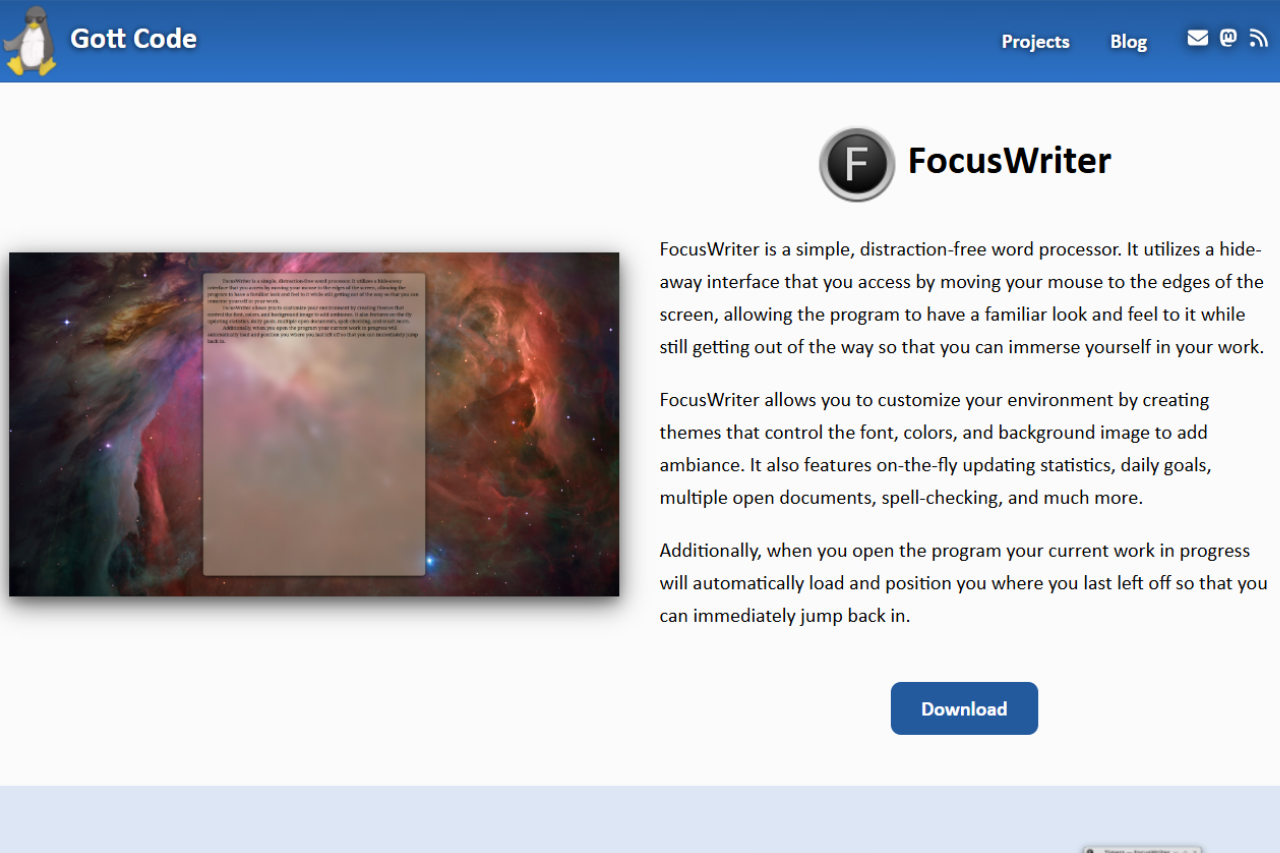
FocusWriter is a free, GPL-3.0 writing application developed by Graeme Gott. It runs on Linux and Windows and hides the desktop behind a full-screen writing surface. Features include customizable themes, typewriter sound effects, daily word-count goals, session statistics, and export to .odt and .docx. There is no macOS build, no mobile version, and no cloud sync.
🏆 Our Verdict
FocusWriter is a minimalist writing environment designed to eliminate distractions and enhance productivity for writers. Available for Linux and Windows, this tool is favored for its simplicity and effectiveness, providing a hide-away interface that appears only when needed. While it lacks the cross-platform flexibility and rich text editing features of some competitors, its commitment to a clutter-free workspace makes it a strong contender for those seeking focused writing sessions.
✅ Pros & ❌ Cons
Pros
Distraction-Free Interface: Helps maintain focus with a clean, hide-away design.
Customizable Themes: Allows users to tailor the writing environment to their liking.
Typewriter Sound Effects: Offers an immersive writing experience.
Goal Setting: Enables writers to set daily word count or time goals.
Portable Mode: Can run from a USB stick without installation on the host computer.
No Native macOS Support: Lacks direct compatibility with macOS, though it can be run using compatibility layers.
Basic Text Editing: Lacks advanced formatting tools, suitable mostly for plain text writing.
No Mobile Version: No availability on mobile platforms for writing on the go.
No Real-Time Cloud Sync: Does not offer built-in cloud synchronization options.
📖 About
FocusWriter is developed with the intention of providing writers a peaceful place to concentrate solely on their writing. It is engineered to reduce distractions by featuring a full-screen mode that isolates the writing tool from other desktop clutter, enhancing focus and potentially increasing productivity.
🗓️ How It Works
Download and Install: Easily install FocusWriter on compatible operating systems from the official website.
Customize Your Workspace: Adjust the themes and settings to create your ideal writing environment.
Set Goals: Utilize the built-in timers and word count goals to track writing sessions.
Write in Peace: Begin writing in a user-friendly interface that stays out of the way until you need it.
Save and Manage Documents: Use session management to save progress and manage multiple documents easily.
A concrete NaNoWriMo workflow
A concrete 2026 workflow looks like this: install FocusWriter 1.8.x on Linux or Windows, point its auto-save folder at a synced directory (Syncthing, Synology Drive, or iCloud Drive on macOS via the Files app), and use one theme per project so visual context tells you which manuscript you’re in. Set a 1,667-word daily goal during NaNoWriMo (or 500 words on non-novel days), let auto-save fire every minute, and never quit on a blank page — leave a half-finished sentence so tomorrow’s session starts warm.
💲 Pricing Overview
FocusWriter is free under the GPLv3 open-source license. Every feature works without payment. The developer accepts donations via the official site at gottcode.org/focuswriter for users who want to support continued development; donations are voluntary and unlock no premium features.
🥊 Competition
Feature
FocusWriter
iA Writer
Platform Compatibility
Windows, Linux
Windows, Mac, iOS, Android
Interface
Distraction-free, minimal
Streamlined, modern
File Format Support
TXT, RTF, basic ODT
DOCX, Markdown, PDF
Syncing Capabilities
None
Seamless cloud sync across all devices
Pricing
Free
Paid (subscription model)
Typewriter Sounds
Yes
No
Related distraction-free writing tools
If you write primarily in Markdown and want export to EPUB or PDF that FocusWriter does not natively offer, our Typora review covers a paid alternative that pairs a clean editor with broader export formats; for a Windows-only freebie, see our MarkdownPad review.
Three alternatives covered on Startup Stack are useful neighbors: Manuskript for a structured long-form novelist tool with character and plot tracking, Highland 2 for screenplays in the Fountain format, and iA Writer if you need a native macOS or iOS option (FocusWriter has no signed macOS build).
Tool
Pricing (2026)
Platforms
Distraction-free mode
Export formats
FocusWriter
Free (GPLv3)
Linux, Windows, macOS via compatibility layer
Default — full-screen, themeable
TXT, RTF, ODT
Manuskript
Free (GPLv3)
Linux, Windows, macOS
Yes (full-screen mode)
DOCX, ODT, HTML, Markdown
iA Writer
$49.99 desktop / $4.99 mo iOS
macOS, iOS, Windows, Android
Default — focus mode + typewriter scroll
DOCX, PDF, HTML, Markdown
Typora
$14.99 one-time (3 devices)
Linux, Windows, macOS
Yes (zen + focus modes)
DOCX, PDF, HTML, EPUB, Markdown
How FocusWriter compares to the other distraction-free writing apps we cover in 2026. For Markdown-first writers, see our Typora review; Windows users on a budget should also look at our MarkdownPad review.
FocusWriter and NaNoWriMo in 2026
FocusWriter 1.9.0 shipped in February 2025, adding keyboard shortcuts for heading levels and fixing several rendering bugs. The version on the official site is current as of this update.
The 1,667 words-per-day goal built into FocusWriter’s tracker maps to a 50,000-word November draft. That number comes from the original National Novel Writing Month format — write 50,000 words in 30 days. The organization behind NaNoWriMo shut down on March 31, 2025, following two years of public disputes: first over forum moderation failures and allegations of delayed response to reports of misconduct, then over the board’s decision not to take a position against AI-generated text in submissions, which prompted several prominent authors to resign from the advisory board.
The event itself has not disappeared. A group of longtime NaNoWriMo volunteers, educators, and the original founder Chris Baty launched nano2.org as a community-led replacement that runs the same November challenge. A separate group, the Order of the Written Word, formed specifically for writers who want a space that does not permit AI-generated content. FocusWriter’s goal-tracking feature works with either community — or with no community at all if you prefer to write in private.
❓ Frequently asked questions about FocusWriter
Is FocusWriter free?
Yes. FocusWriter is released under the GPL-3.0 license and costs nothing. The developer, Graeme Gott, accepts voluntary donations through the official site, but every feature works without payment. There is no paid tier, no trial watermark, and no feature-gated edition.
FocusWriter vs iA Writer: which one should I pick?
Choose FocusWriter if you write on Linux or Windows, want a free tool, and need daily word-count goals. Choose iA Writer if you work on macOS or iOS, write in Markdown, and want iCloud sync across devices. The two tools do not overlap on platform: FocusWriter has no macOS build, and iA Writer has no Linux build.
Does FocusWriter run on macOS?
No native macOS build exists. FocusWriter runs on Linux and Windows, and also ships a portable .zip for Windows that runs from a USB drive without installation. Some users run it on macOS via Wine or CrossOver, but Graeme Gott does not maintain or test a macOS version, so compatibility is not guaranteed and may break on OS updates.
Can I use FocusWriter for NaNoWriMo or long-form writing?
Yes. FocusWriter includes daily word-count goal tracking and a session timer, which map directly onto the standard 1,667 words-per-day target for a 50,000-word November draft. You set the goal in the preferences, and the status bar shows your progress as a percentage. For long-form work, each chapter can be a separate file; the application does not have a built-in project manager, so a dedicated folder per project is the standard approach.
Can I sync FocusWriter with Dropbox or iCloud?
FocusWriter has no built-in sync. You can point FocusWriter at a folder inside your Dropbox or Google Drive directory and the cloud client will upload the file each time you save — but that is the desktop sync client doing the work, not FocusWriter. There is no real-time sync, no version history inside the app, and no conflict resolution if two devices write to the same file simultaneously. iCloud Drive works the same way on machines where the iCloud client runs, though FocusWriter itself has no macOS build, so iCloud is only relevant if you run FocusWriter on a Windows machine with iCloud installed.
Does FocusWriter export to .docx?
Yes. FocusWriter exports to both .odt (OpenDocument Text) and .docx (Microsoft Word) in addition to plain .txt and .rtf. The .docx export covers body text, bold, italic, and paragraph breaks. Complex formatting such as headers, footnotes, and tracked changes will not carry over because FocusWriter does not support those features in its editor — so what you write is what exports. If you need those elements, open the .odt file in LibreOffice Writer after export.
📌 Conclusion
FocusWriter stands out as a preferred tool for writers who prioritize a focused and minimalist writing environment. It strips away the bells and whistles of more complex word processors in favor of a straightforward, distraction-free experience. While it may not suit those needing advanced formatting or cloud-based features, for writers dedicated to simplicity and productivity, FocusWriter is an excellent choice.
FocusWriter: Simplify Your Writing Space, Amplify Your Words
Related read: FocusWriter clears the screen so you can draft without distraction, but it leaves the structure to you. If you want that same free, open-source spirit with an outliner, character sheets, and plot tracking built in, our Manuskript review covers a tool made for organising a long manuscript.
When the draft outgrows a blank screen: FocusWriter deliberately holds nothing but the text. Once a project needs chapters, character sheets and research in the same place, Quoll Writer keeps the same free, offline, no-account footing and adds the structure.
Troubleshooting FocusWriter: negative goals, missing dictionaries and silent sound effects
FocusWriter has one maintainer and a short bug list, so most of what gets reported has already been fixed in a later build. The current release is 1.9.1, published on 23 July 2026. Check your version before anything else, because three of the four problems below were closed in it.
The daily goal shows a negative word count
This is a known defect, not something you configured wrong. Daily progress was sometimes reported as a negative number, and the fix shipped in 1.9.1. Update and the counter reads correctly again. If you are stuck on an older build because of a package repository that lags, the goal itself still tracks; only the figure on the status bar is wrong.
Spell check underlines every word, or your language is missing
FocusWriter does not ship its own dictionaries. It uses hunspell, which the Windows builds bundle at version 1.7.3 and which Linux expects you to install separately alongside Qt. On Linux, install the hunspell package for your language through your distribution and FocusWriter picks it up. If the dictionaries live somewhere non-standard, set the DICPATH environment variable to that folder: support for it was added in 1.8.10 for exactly this case.
Typewriter sounds go silent on accented characters
Two separate bugs, both closed. Sound effects did not play for smart quotes, which was fixed in 1.9.0, and they did not play for composed text, which was fixed in 1.9.1. Composed text is what you get from a dead key or an input method, so this hit anyone typing accents, umlauts or a non-Latin script. Nothing in the preferences works around it. The update is the fix.
Scene list entries overlap on Windows 11
A rendering fault in the scene list on Windows 11, closed in 1.9.1. Entries drew on top of each other and made the list unreadable while the document underneath stayed intact. Nothing is lost, and no reinstall is needed beyond moving to the current build.
Your work does not reopen where you left it
FocusWriter is meant to reload your work in progress on launch and put the cursor back where it was, so a session that opens blank means the program is not seeing its own settings. That is usually a second copy: a portable build unzipped somewhere new keeps its state in its own folder, not next to the installed version’s. Run one or the other, not both.
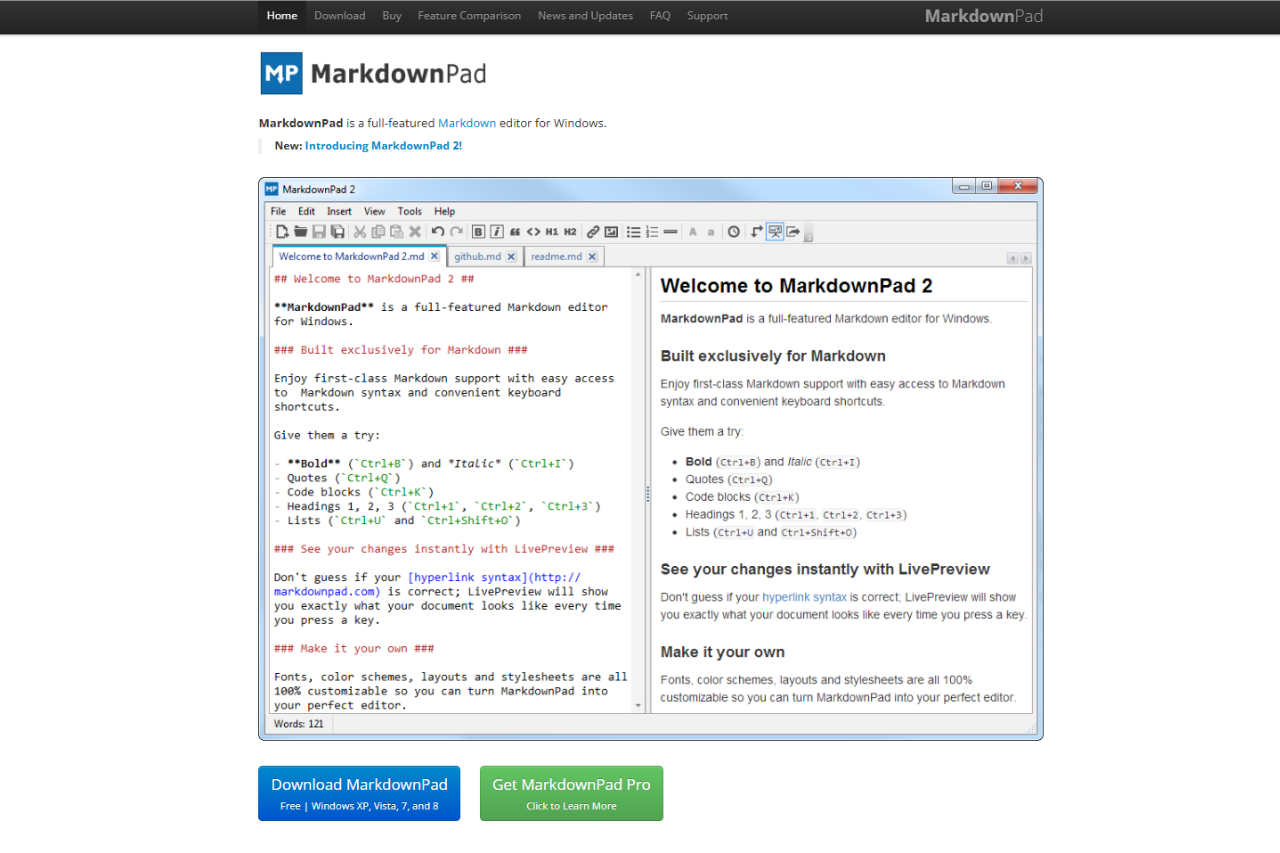
MarkdownPad 2.5 came out on 24 December 2014, and on 29 September 2026 it is still the latest version. The official site lists Windows XP, Vista, 7 and 8. If LivePreview shows “This view has crashed!”, install the Awesomium 1.6.6 SDK from the MarkdownPad FAQ. A Pro license costs $14.95 for one user. On macOS or Linux, try Typora instead.
🏆 Our Verdict
MarkdownPad is a dedicated Markdown editor optimized for Windows users, combining a user-friendly interface with effective functionality. Its real-time preview and customizable themes make it ideal for those who need to convert plain text into well-formatted documents quickly. Despite lacking some advanced features such as full cross-platform support and extensive multimedia integration, MarkdownPad’s straightforward design and strong core functionalities make it an attractive choice for Markdown enthusiasts on Windows.
✅ Pros & ❌ Cons
Pros
Real-Time Preview: Instantly see how your Markdown translates into formatted text.
Customizable Interface: Alter the editor’s appearance with custom themes and layouts.
Windows Optimization: Specifically designed for Windows, ensuring smooth performance and integration.
Extensive Format Support: Handles various Markdown extensions for tables, code syntax highlighting, and more.
Affordable Licensing: Offers a straightforward and low-cost license compared to subscription models.
Cons
No Cross-Platform Support: Limited to Windows, unavailable on macOS or Linux.
Limited Multimedia Support: Does not natively embed multimedia content like videos.
No Mobile Version: No options for editing on mobile devices.
Basic Collaboration Tools: Lacks features for real-time collaboration or advanced version control.
Dependency on .NET: Requires .NET Framework to operate, which might be a barrier for some users.
📖 About
MarkdownPad is tailored for Windows users who need a powerful yet straightforward tool to write and convert text into HTML using the Markdown language. It is designed to offer a seamless experience with features like instant HTML previews, customizable CSS, and full control over the editor’s interface.
🗓️ How It Works
Open MarkdownPad: Download and install MarkdownPad on your Windows device.
Start a New Document: Begin typing in Markdown syntax.
Customize Appearance: Adjust the theme and layout to suit your preferences.
Preview Your Work: Utilize the split-screen feature to view your Markdown and HTML side by side.
Export Your Document: Save or export your document as HTML, PDF, or another supported format.
💲 Pricing Overview
MarkdownPad offers two versions: Basic and Pro. The Basic version is free, while the Pro version requires a one-time payment that grants access to additional features like advanced customization and extended export options.
🥊 Competition
Feature
MarkdownPad
Typora
Platform
Windows only
Cross-platform (Windows, Mac, Linux)
Real-Time Preview
Yes
Yes
Theme Customization
Limited
Extensive
Pricing
Free and Pro (one-time fee)
Free during beta; Paid post-beta
Offline Access
Yes
Yes
Export Options
HTML, PDF
HTML, PDF, Word, and more
Collaboration
Basic
Basic
User Interface
Traditional with customization
Minimalist and modern
📌 Conclusion
MarkdownPad shines as a robust Markdown editor specifically for Windows users, focusing on efficiency and simplicity. While it serves its purpose admirably for individual projects and basic web writing tasks, those requiring more extensive features or cross-platform compatibility might consider alternatives like Typora. Despite these limitations, MarkdownPad remains a favored choice for those committed to the Windows platform.
MarkdownPad: Simplify Your Writing, Optimize Your Workflow
MarkdownPad keeps files local on Windows. If cloud sync across machines matters more than a native installer, see our StackEdit review for the browser-first alternative.
Related read: MarkdownPad is a Windows-only Markdown editor. For a cross-platform notebook with code-block highlighting and local files you keep offline, Boostnote is worth a look.
Quiver is a specialized note-taking app tailored specifically for programmers and technical professionals. With its unique cell-based approach to note composition, which allows for the integration of text, code, and Markdown within a single note, Quiver is exceptionally suited for those who need a robust tool for code snippets, algorithms, and technical documentation. However, its focus on code and technical content might limit its appeal to non-technical users, and it lacks broader collaborative features found in some competitors.
✅ Pros & ❌ Cons
Pros
Cell-Based Note Structure: One note can mix text, code, Markdown, LaTeX and diagram cells.
Syntax Highlighting: Supports over 120 programming languages.
Live Preview: Markdown and LaTeX cells show the rendered result while you type.
Extensive Export Options: Notes can be exported to PDF, HTML, and more.
Integrated Backup and Sync: Syncs your library between Macs through Dropbox, iCloud Drive, Google Drive or any other file-based cloud service.
Cons
Limited Appeal for Non-Technical Users: Features are heavily tailored towards programmers, which may not be as useful for general note-taking.
No Real-Time Collaboration: Lacks the capability for multiple users to edit notes simultaneously.
Platform Limitation: Primarily available only for macOS, limiting its accessibility.
No Web or Mobile App: Lacks a dedicated web or mobile interface, restricting usage to Mac computers.
Premium Price: Requires purchase after a trial period, which might deter those looking for a free tool.
📖 About
Quiver is dubbed “The Programmer’s Notebook,” designed to serve as a comprehensive note-taking environment for software developers and technical writers. It combines the simplicity of a notepad with the power of an integrated development environment (IDE), offering features that enhance productivity and organization of complex information.
🗓️ How It Works
Start Quiver: Download and install Quiver on a macOS system.
Create a New Note: Utilize cells to add text, code, or Markdown.
Organize Your Notebook: Use tags and libraries to categorize and retrieve notes efficiently.
Sync and Backup: Keep the library in Dropbox, iCloud Drive, Google Drive or another file-based cloud folder to sync it across your Macs.
Export Notes: Convert your notes into various formats for sharing or publishing.
Customize Appearance: Tailor the interface and editing options to your preferences.
💲 Pricing Overview
Quiver offers a one-time purchase model, typically priced at $9.99, which includes all features without any additional subscriptions or in-app purchases.
🥊 Competition
Feature
Quiver
Evernote
Cost
One-time purchase
Free tier, with premium subscriptions
Offline Access
Full offline functionality
Limited in free tier
Cloud Integration
Dropbox, iCloud Drive, Google Drive or any file-based cloud
Extensive options including its own service
Live Markdown Preview
Yes
No
Collaboration
Shared notebooks your team can view or edit
Extensive collaboration tools
Customization
High for technical users
General user customization
Ease of Use
Moderate learning curve
User-friendly for non-technical users
Export Options
Extensive (PDF, HTML, etc.)
Mostly limited to paid users
Quiver FAQ
What is a note in Quiver?
A Quiver note is a stack of cells. Each cell holds text, code, Markdown, LaTeX or a diagram (a sequence diagram or a flowchart), and one note can mix all five. Code cells run the ACE editor with syntax highlighting for more than 120 languages and over 20 themes. Each code cell can have its own language. Markdown and LaTeX cells render in a live preview as you type. LaTeX cells go through MathJax, which supports math-mode macros only. Notes sit in notebooks, and you can tag them and link one note to another.
Is Quiver only for Mac?
Yes. The App Store lists it as a Mac app, and it needs macOS 10.13 or later. Version 3.3 added Apple Silicon support on 18 June 2026. That was the first update in nearly seven years, since 3.2.7 in September 2019, and 3.3.1 followed on 26 June. The developer also offers the Quiver Web Clipper, a Chrome extension.
How much does Quiver cost?
$9.99, paid once on the Mac App Store, with no subscription. Family Sharing covers up to six family members. The developer’s site, yliansoft.com, has a free trial download if you want to try it before you pay.
Where does Quiver keep my notes, and how do I sync them?
In plain JSON files on your Mac. To sync between Macs, put the library in Dropbox, iCloud Drive, Google Drive or any other file-based cloud folder. Backup is one click for the whole library, and restore is just as quick. You can export notes to HTML and PDF. Because the files are plain JSON, you can also script against them or keep them under version control.
Can my team share Quiver notes?
Yes, through a shared notebook that everyone on the team can view or edit. The developer suggests it for a shared team knowledge base. Its feature list does not mention real-time co-editing.
Can I bring my notes over from Evernote?
Yes. Quiver includes an Evernote importer.
📌 Conclusion
Quiver stands out as a powerful, if niche, note-taking app that excels in environments where technical documentation and code management are required. Its unique cell-based note structure and comprehensive support for programming languages make it a standout choice for developers and technical professionals. While it may not cater to the broader market due to its lack of real-time collaboration and platform limitations, for its target audience, Quiver offers unmatched functionality.
Related read: Quiver mixes text, code, and Markdown cells inside one notebook. If you want a free, open-source app built around the same developer-notes idea, Boostnote is worth a look. It leans harder into Markdown-first editing and offline storage.
Related read: Quiver splits a note into cells so text, code and Markdown each get their own editor. If you would rather keep one plain Markdown file and watch it render as you type, Typora is the other shape that idea takes on the Mac.
This website uses cookies to ensure you get the best experience on our website. Surfing the website you are authorizing the use of cookies.
Privacy & Cookies Policy
Privacy Overview
This website uses cookies to improve your experience while you navigate through the website. Out of these cookies, the cookies that are categorized as necessary are stored on your browser as they are essential for the working of basic functionalities of the website. We also use third-party cookies that help us analyze and understand how you use this website. These cookies will be stored in your browser only with your consent. You also have the option to opt-out of these cookies. But opting out of some of these cookies may have an effect on your browsing experience.
Necessary cookies are absolutely essential for the website to function properly. This category only includes cookies that ensures basic functionalities and security features of the website. These cookies do not store any personal information.
Any cookies that may not be particularly necessary for the website to function and is used specifically to collect user personal data via analytics, ads, other embedded contents are termed as non-necessary cookies. It is mandatory to procure user consent prior to running these cookies on your website.