Kile: The Essential LaTeX Editor for Streamlined Academic Writing

πŸ† Our Verdict

TeXstudio emerges as the ultimate LaTeX editor for users who need an advanced, yet user-friendly environment for writing and managing their documents. As a standout in its category, TeXstudio provides a feature-rich platform that supports extensive LaTeX capabilities along with a suite of powerful tools, making it essential for both academic and professional writing tasks. While Kile offers robust features, TeXstudio’s superior interface and additional functionalities like real-time previewing make it the better choice for users seeking comprehensive LaTeX document management.

βœ… Pros & ❌ Cons

Pros of Kile:

  • Comprehensive LaTeX Support: Offers a broad range of LaTeX tools which is ideal for complex document creations.
  • Open Source and Free: Available at no cost, making it accessible to everyone without financial burden.
  • Platform Compatibility: Runs on KDE, providing a stable environment for Linux users.

Cons of Kile:

  • Limited Interface Appeal: Less modern interface compared to TeXstudio, which might affect user experience.
  • Less Intuitive: Might require a steeper learning curve for new users unfamiliar with LaTeX.

Pros of TeXstudio:

  • Highly Customizable Interface: More modern and user-friendly, enhancing user engagement and productivity.
  • Real-time Preview Features: Allows users to see changes instantly, which is a significant advantage over Kile.
  • Extensive Documentation Support: Great for managing large projects with complex documentation needs.

Cons of TeXstudio:

  • Higher Resource Usage: Might consume more system resources compared to lighter editors like Kile.
  • Potentially Overwhelming for Beginners: The vast array of features might be daunting for new or casual LaTeX users.

πŸ“– About Kile

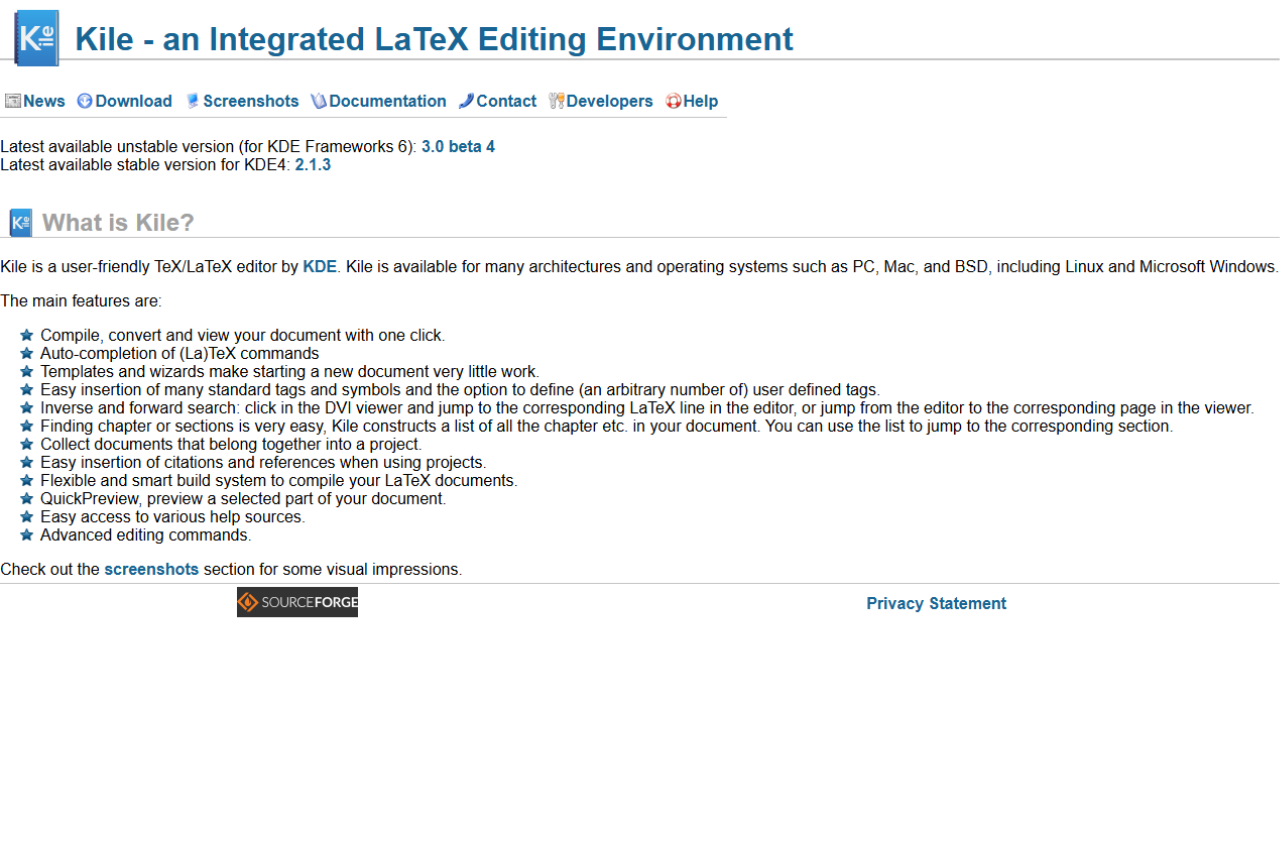
Kile is an open-source LaTeX editor, designed to offer an advanced textual content editing interface for LaTeX documents. While primarily aimed at users familiar with the KDE desktop environment, it catifies robust tools to facilitate the creation of complex academic and scientific documents. Kile simplifies the LaTeX document creation process through its structured interface that accommodates numerous templates and tools aimed at enhancing productivity.

πŸ—“οΈ How It Works

  1. Setup and Installation
    • Download and install Kile from the official repository or as part of the KDE software compilation.
  2. Starting a New Project
    • Easily start new projects with pre-defined or custom templates.
  3. Editing and Document Management
    • Utilize side panels and document structure views to manage chapters, sections, and tags efficiently.
  4. Compiling Documents
    • Quick access to compile buttons allows for easy document building and viewing in PDF format.
  5. Advanced Features
    • Utilize scripts and build tools to customize the compilation process, integrating external tools seamlessly.

πŸ’² Pricing Overview

Kile is completely free to use, which provides significant value considering its extensive features and capabilities without any cost.

πŸ₯Š Competition: Kile vs. TeXstudio

FeatureKileTeXstudio
CostFreeFree
InterfaceBasic, less modernHighly customizable, modern
Compilation ToolsExtensive, customizableExtensive, more integrated
Document PreviewBasic preview capabilitiesReal-time previewing
User SupportCommunity forums, documentationExtensive documentation, community support

πŸ“Œ Conclusion

Kile stands out as a solid choice for LaTeX users who are looking for a robust, no-cost editor that integrates seamlessly with the KDE desktop environment. While it might not have the sleek interface of some newer editors like TeXstudio, its comprehensive toolset and open-source nature make it a reliable option for students and professionals working on complex documents. However, for those seeking a more modern experience with additional features like real-time preview, alternatives like TeXstudio may be more appealing.

Kile: Streamlined LaTeX Editing for Academia and Beyond

Related read: Kile is built around KDE and gives you project management on top of LaTeX. If you want something that runs the same on any desktop and ships with your TeX distribution, TeXworks is the lighter starting point.

Related read: Kile is a KDE application, so it is at home on Linux and awkward anywhere else. The equivalent argument on the other side of that line is WinEdt, which is Windows-only by design and spends the same effort on deep configurability rather than on running everywhere.

Related read: Kile runs on KDE, which is a stable home on Linux and an awkward one anywhere else. If you move between a Linux box and a Mac or a Windows machine, Texmaker is the closest equivalent that is the same program on all three, with the same Qt interface and the same built-in PDF viewer.
Paperpile: Revolutionizing Research Reference Management

πŸ† Our Verdict

Paperpile is a modern, web-based reference management tool tailored for researchers, students, and academics who require efficient, seamless integration with Google services. It excels in simplifying the process of citation management, especially for users heavily invested in Google Docs and Google Scholar. Compared to Zotero, which offers broad compatibility with multiple browsers and word processors, Paperpile’s tight integration with Google products makes it particularly appealing for users within that ecosystem, providing a streamlined user experience that enhances productivity.

βœ… Pros & ❌ Cons

Pros

  • Seamless Google Integration: Optimized for Google Docs and Google Scholar, making it ideal for users of Google’s suite.
  • User-Friendly Interface: Clean, minimalistic design that’s easy to navigate.
  • Automatic PDF Download and Annotation: Efficient management of PDFs with direct downloading and annotation capabilities.
  • Cloud-Based: Accessible from anywhere, with all data securely stored in the cloud.
  • Collaboration Features: Facilitates easy collaboration via Google Docs.

Cons

  • Platform Dependency: Primarily designed for Google Chrome; limited functionality with other browsers.
  • Subscription Model: No free version available; requires a subscription.
  • Limited Offline Functionality: Most effective with an internet connection.
  • Fewer Citation Styles: While extensive, the citation styles library is not as comprehensive as Zotero’s.

πŸ“– About

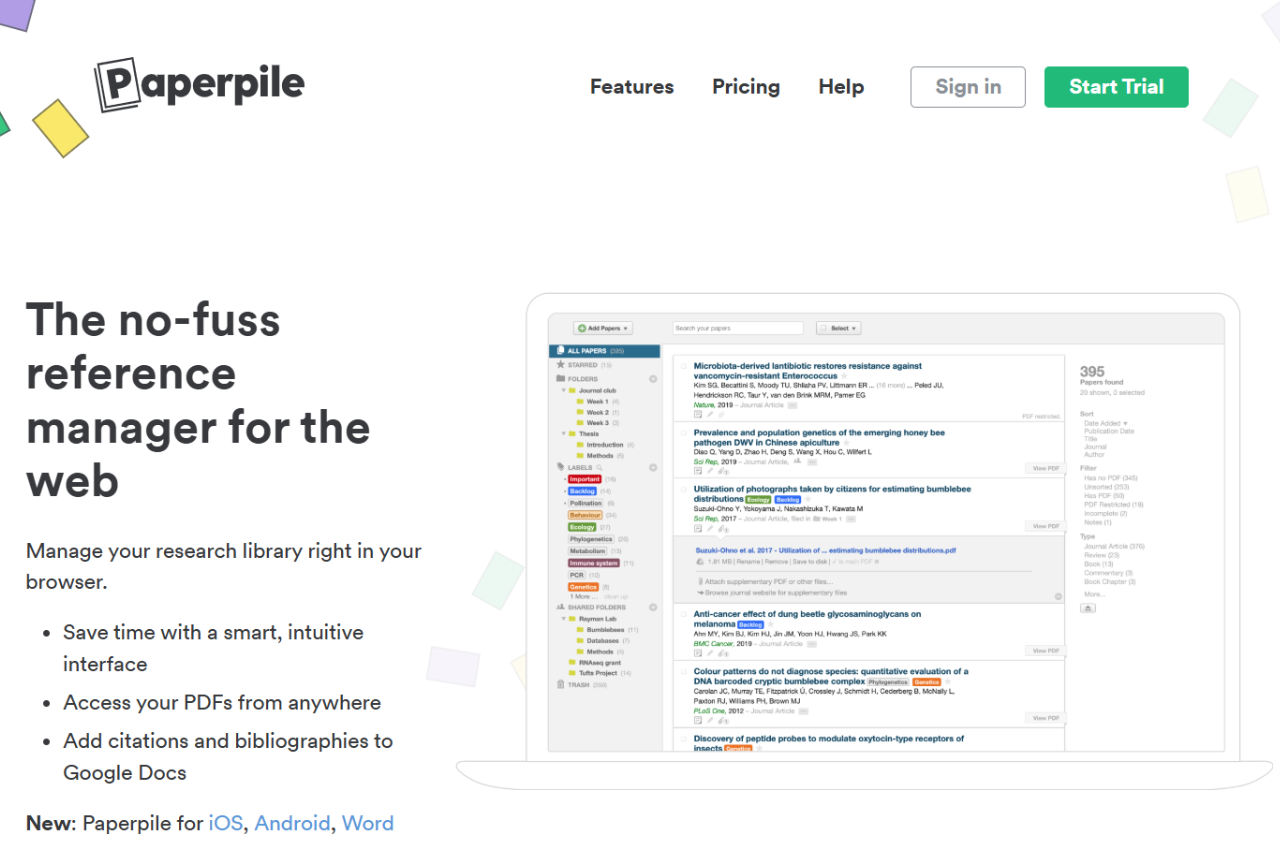
Paperpile is designed to streamline the research process by managing references, PDFs, and citations directly within Google Docs. It’s aimed at making academic writing cleaner, more efficient, and more connected.

πŸ—“οΈ How It Works

  1. Setup and Integration: Install the Paperpile extension for Google Chrome.
  2. Import References: Easily import references from academic databases, websites, and existing libraries.
  3. Organize and Annotate: Organize articles and PDFs in folders, tag them, and annotate directly within the browser.
  4. Cite While You Write: Use the Google Docs add-on to insert citations and format bibliographies automatically.
  5. Collaborate in Real-Time: Share papers and collaborate on bibliographies with peers via Google Docs.

πŸ’² Pricing Overview

Paperpile offers a range of pricing options tailored for different users, focusing primarily on accessibility and ease of use for academic and business purposes:

  • Free Plan: While Paperpile offers a free trial, they do not have a permanent free version available. The trial allows users to test out features before committing to a subscription.
  • Academic Plan: Priced at $2.99 per month, this plan is geared towards students, faculty, and other academic professionals. It includes features tailored for research management, such as PDF download and sync, annotation, organization tools, and citation support in Google Docs.
  • Business Plan: At $9.99 per month, this plan targets business users and includes all the features of the Academic plan with additional support tailored for professional use in a business environment.

πŸ₯Š Competition

FeaturePaperpileZotero
Platform IntegrationGoogle Chrome, Google DocsFirefox, Chrome, Safari; MS Word, LibreOffice
User InterfaceModern and intuitiveFunctional, less modern
AccessCloud-based, primarily onlineBoth cloud and local storage, works offline
CollaborationIntegrated with Google Docs for live collaborationSupports group libraries and shared collections
PricingSubscription onlyFree, with paid storage options

πŸ“Œ Conclusion

Paperpile is a robust tool for anyone embedded in the Google ecosystem, offering streamlined, efficient management of research materials and citations. While it may not have the wide-ranging compatibility of Zotero, its specialized focus on Google products makes it an excellent choice for users looking for simplicity and integration in their research processes.

Paperpile: Streamline Your Research in the Cloud

Quiver: The Programmer’s Notebook

πŸ† Our Verdict

Quiver is a specialized note-taking app tailored specifically for programmers and technical professionals. With its unique cell-based approach to note composition, which allows for the integration of text, code, and Markdown within a single note, Quiver is exceptionally suited for those who need a robust tool for code snippets, algorithms, and technical documentation. However, its focus on code and technical content might limit its appeal to non-technical users, and it lacks broader collaborative features found in some competitors.

βœ… Pros & ❌ Cons

Pros

  • Cell-Based Note Structure: Unique approach allows mixing text, code, and Markdown in one note.
  • Syntax Highlighting: Supports over 120 programming languages.
  • Live Preview: Markdown and code cells have a live preview to see the results immediately.
  • Extensive Export Options: Notes can be exported to PDF, HTML, and more.
  • Integrated Backup and Sync: Supports syncing across devices via iCloud or external services like Dropbox.

Cons

  • Limited Appeal for Non-Technical Users: Features are heavily tailored towards programmers, which may not be as useful for general note-taking.
  • No Real-Time Collaboration: Lacks the capability for multiple users to edit notes simultaneously.
  • Platform Limitation: Primarily available only for macOS, limiting its accessibility.
  • No Web or Mobile App: Lacks a dedicated web or mobile interface, restricting usage to Mac computers.
  • Premium Price: Requires purchase after a trial period, which might deter those looking for a free tool.

πŸ“– About

Quiver is dubbed “The Programmer’s Notebook,” designed to serve as a comprehensive note-taking environment for software developers and technical writers. It combines the simplicity of a notepad with the power of an integrated development environment (IDE), offering features that enhance productivity and organization of complex information.

πŸ—“οΈ How It Works

  1. Start Quiver: Download and install Quiver on a macOS system.
  2. Create a New Note: Utilize cells to add text, code, or Markdown.
  3. Organize Your Notebook: Use tags and libraries to categorize and retrieve notes efficiently.
  4. Sync and Backup: Set up cloud syncing with iCloud or Dropbox to keep notes updated across devices.
  5. Export Notes: Convert your notes into various formats for sharing or publishing.
  6. Customize Appearance: Tailor the interface and editing options to your preferences.

πŸ’² Pricing Overview

Quiver offers a one-time purchase model, typically priced at $9.99, which includes all features without any additional subscriptions or in-app purchases.

πŸ₯Š Competition

FeatureQuiverEvernote
CostOne-time purchaseFree tier, with premium subscriptions
Offline AccessFull offline functionalityLimited in free tier
Cloud IntegrationiCloud, DropboxExtensive options including its own service
Live Markdown PreviewYesNo
CollaborationNoneExtensive collaboration tools
CustomizationHigh for technical usersGeneral user customization
Ease of UseModerate learning curveUser-friendly for non-technical users
Export OptionsExtensive (PDF, HTML, etc.)Mostly limited to paid users

πŸ“Œ Conclusion

Quiver stands out as a powerful, if niche, note-taking app that excels in environments where technical documentation and code management are required. Its unique cell-based note structure and comprehensive support for programming languages make it a standout choice for developers and technical professionals. While it may not cater to the broader market due to its lack of collaboration features and platform limitations, for its target audience, Quiver offers unmatched functionality.

Quiver: Code More, Note More, Do More

Related read: Quiver mixes text, code, and Markdown cells inside one notebook. If you want a free, open-source app built around the same developer-notes idea, Boostnote is worth a look — it leans harder into Markdown-first editing and offline storage.

Related read: Quiver splits a note into cells so text, code and Markdown each get their own editor. If you would rather keep one plain Markdown file and watch it render as you type, Typora is the other shape that idea takes on the Mac.

StackEdit: The Ultimate Online Markdown Editor

πŸ† Our Verdict

StackEdit is a versatile, web-based Markdown editor designed for writers, developers, and professionals who need a powerful, browser-friendly tool for creating and managing documents. With its seamless cloud integration, live preview feature, and support for advanced Markdown formatting, StackEdit is a must-have for those seeking a reliable and accessible Markdown editor. While it lacks offline functionality and advanced collaboration tools, its wide range of export options and intuitive interface make it a standout choice for individual users.

βœ… Pros & ❌ Cons

Pros

  • Web-Based and Lightweight: No installation required; accessible directly from your browser.
  • Live Markdown Preview: Instantly see formatted content alongside your code.
  • Cloud Integration: Sync with Google Drive, Dropbox, and GitHub for easy document management.
  • Export Versatility: Save files as PDF, Word, HTML, or raw Markdown.
  • Extensive Markdown Features: Supports tables, footnotes, and mathematical expressions.
  • Free to Use: No hidden fees or premium features.

Cons

  • No Offline Access: Requires an internet connection to function.
  • Limited Collaboration Tools: Does not support real-time collaborative editing.
  • Basic UI Design: The interface feels dated compared to modern editors.
  • Learning Curve: Advanced features may overwhelm beginners.
  • Dependency on Browser: Limited functionality on mobile browsers.

πŸ“– About

StackEdit is a free, open-source Markdown editor accessible entirely from your web browser. Designed for both beginners and power users, it provides a feature-rich environment for creating and managing Markdown documents. With integrations for cloud storage and Git-based platforms, StackEdit simplifies workflows for developers, writers, and students who rely on Markdown for structured writing.

πŸ—“οΈ How It Works

1. Access the Editor

Open StackEdit at https://stackedit.io/ on any modern browser.

2. Create a New Document

Start writing in Markdown, using the live preview panel to see formatted content in real time.

3. Organize and Sync Files

Sync your documents with Google Drive, Dropbox, or GitHub for easy access and version control.

4. Use Advanced Markdown Features

Add tables, equations, or footnotes for detailed documentation.

5. Export Your Work

Save files in various formats, including PDF, Word, and HTML.

6. Publish Online

Publish directly to platforms like WordPress or export to GitHub Pages for web-based content.

πŸ’² Pricing Overview

StackEdit is completely free to use. All features, including cloud synchronization and export options, are available without any subscription fees or hidden costs.

πŸ₯Š Competition

FeatureStackEditDillinger
CostFreeFree
Offline AccessNoNo
Cloud IntegrationSupports Google Drive, Dropbox, GitHubSupports Dropbox and GitHub
Live Markdown PreviewYesYes
CollaborationLimitedLimited
CustomizationAdvanced features for Markdown formattingBasic customization
Ease of UseRequires some learning curveBeginner-friendly
Export OptionsExtensive (PDF, Word, HTML, Markdown)Limited to Markdown export

πŸ“Œ Conclusion

StackEdit is a powerful and versatile Markdown editor that caters to users seeking a web-based solution for writing and managing structured documents. Its robust feature set, including live preview, cloud integration, and export options, makes it an excellent choice for developers and writers. Although it lacks offline capabilities and advanced collaboration tools, StackEdit remains a top contender for those prioritizing accessibility and efficiency.

StackEdit: Markdown Made Simple, Anywhere, Anytime

How StackEdit fits a 2026 writing workflow

StackEdit runs in the browser and stores files in localStorage by default, so closing the tab keeps the current draft intact. Connecting Google Drive, Dropbox, or GitHub turns it into a multi-device editor without installing anything locally. The split-pane preview re-renders on each keystroke, and tables, fenced code, KaTeX math, and Mermaid diagrams all render without plugin setup.

Offline use works through the PWA install. Click the install button in the browser address bar and StackEdit launches in its own window, similar to a native desktop app. Pricing stayed free for personal use in 2026. The Pro tier at $4.99 a month removes ads and adds Couchbase sync for teams, which is the main thing missing from the free build.

Exporting and publishing from StackEdit

Writing is only half the job. StackEdit exports a finished document as Markdown, HTML, or a styled PDF, so the same draft can go to a static site, a CMS, or a client without reformatting. The HTML export keeps the rendered headings, tables, and code blocks intact, which saves a cleanup pass when you paste into a page builder.

StackEdit also publishes straight to external services. You can connect WordPress, Blogger, Zendesk, or a GitHub Gist and push the current file to it, then update the same target later instead of copying text by hand. For teams that draft in Markdown but ship to a hosted blog, that publish step is what makes a browser editor practical rather than a scratchpad. Files stay in your linked Google Drive or Dropbox folder, so the source of truth is a plain .md file you own.

Related read: StackEdit runs in the browser for quick Markdown editing. If you want a Markdown notebook that keeps notes on your own machine and works offline, Boostnote covers similar ground for developers.

Boostnote: A Note-Taking Solution Tailored for Developers

πŸ† Our Verdict

Boostnote is a powerful, open-source note-taking tool specifically designed for developers. Its focus on markdown-based notes, code snippet management, and seamless organization makes it a go-to choice for programmers and technical users. While it lacks the advanced multimedia features and integrations of competitors like Evernote, Boostnote excels in providing a lightweight, customizable solution for coding and technical documentation.

βœ… Pros & ❌ Cons

Pros

  • Developer-Focused: Designed for managing code snippets and markdown notes.
  • Open-Source: Fully open-source with community-driven development.
  • Cross-Platform: Available on Windows, macOS, and Linux.
  • Offline-First: Fully functional without an internet connection.
  • Markdown Support: Advanced markdown editor with syntax highlighting.
  • Free to Use: No subscription fees or premium tiers.

Cons

  • Limited Integrations: Lacks integration with major productivity tools like Google Drive or Slack.
  • No Real-Time Collaboration: Not suitable for team-based note-taking or collaboration.
  • Basic UI Design: Minimalistic interface may feel outdated to some users.
  • Multimedia Limitations: Lacks robust support for images, audio, or video notes.
  • Learning Curve: Advanced features may overwhelm non-technical users.

πŸ“– About

Boostnote is an open-source note-taking application tailored for developers and technical professionals. Originally designed to manage code snippets, Boostnote has expanded to support markdown-based documentation and task management. Its offline-first design and focus on coding make it a preferred choice for developers who want a lightweight yet powerful note-taking solution.

πŸ—“οΈ How It Works

1. Create an Account, Download and Install

Boostnote is available for free on https://boostnote.io/ for Windows, macOS, and Linux.

2. Create Notes

Capture ideas using markdown or save reusable code snippets in structured folders.

3. Organize Content

Use tags and folders to categorize notes for easy retrieval.

4. Customize Your Workflow

Choose from various themes and editor configurations to match your preferences.

5. Sync Across Devices

Manually synchronize notes using third-party storage solutions like Dropbox or Google Drive.

6. Collaborate via Git

Leverage Git integration for version control and team collaboration.

πŸ’² Pricing Overview

Boost Note offers three pricing plans to cater to different user needs:

Free Plan

  • Cost: $0 per member/month
  • Features:
    • 14-day free trial
    • No credit card required

Standard Plan

  • Cost:
    • $6 per member/month (monthly billing)
    • $5 per member/month (yearly billing, save up to 20%)
  • Features:
    • Unlimited documents
    • Unlimited dashboards
    • 7-day version history
    • PDF exporting
    • 1 GB storage per member
    • 200 MB per upload
    • Support from the Boost Note team

Pro Plan

  • Cost:
    • $10 per member/month (monthly billing)
    • $8 per member/month (yearly billing, save up to 20%)
  • Features:
    • All Standard Plan features
    • Unlimited version history
    • Private folders
    • 10 GB storage per member
    • Advanced public sharing
    • Priority support

Additional Information:

  • Members: Can create and edit items.
  • Viewers: Free; can view and comment on documents.
  • Billing: Both monthly and yearly options are available, with yearly billing offering up to a 20% discount.
  • Payment Processing: Handled securely through Stripe.
  • Trial Period: After the 14-day free trial, users can read existing documents but cannot add or edit documents without upgrading to a paid plan.

For more details, visit the Boost Note Pricing Page.

πŸ₯Š Competition

FeatureBoostnoteEvernote
CostFreeFree tier, Premium starts at $7.99/month
Developer FocusTailored for coding and markdown notesNot designed specifically for developers
Offline AccessFully functional offlineLimited offline functionality on free plan
CollaborationGit-based version controlReal-time collaboration supported
Markdown SupportAdvancedBasic markdown support
Multimedia NotesLimitedSupports images, audio, and PDFs
CustomizationHigh via themes and configurationsLimited customization options
Ease of UseRequires technical knowledgeBeginner-friendly

πŸ“Œ Conclusion

Boostnote is an excellent choice for developers and technical users seeking a lightweight, markdown-based note-taking tool. While it may not have the advanced integrations and multimedia capabilities of competitors like Evernote, its developer-focused features and open-source nature make it a standout solution for managing code snippets and technical documentation.

Boostnote: The Ultimate Note-Taking Tool for Developers

Boost Note vs Obsidian: which fits a developer in 2026?

Obsidian gets most of the attention in the markdown-notes category, but Boost Note is built for a different audience. Obsidian is a graph-first knowledge tool that rewards heavy linking and a stable vault. Boost Note is a code-first scratchpad: syntax highlighting on every block and a built-in markdown preview that handles Mermaid and PlantUML diagrams without a plugin install.

The developer workflow Boost Note is good at

Two workflows where Boost Note pulls ahead. Capturing shell snippets while you debug a service: the code-block editor behaves like an IDE, not a word processor, and the snippet notes give one-off scripts somewhere to live. Keeping a personal runbook on a locked-down work laptop: cloud sync is optional, so a machine with restricted network egress still runs offline-first.

When to pick something else

Boost Note is the wrong tool if your notes are mostly prose or if you live inside a team wiki. Reach for StackEdit when you want browser-based markdown with Google Drive sync, or MarkdownPad 2 on Windows for a desktop editor with live HTML preview. Boost Note keeps its edge for engineers who want an editor that thinks in code blocks first and prose second.

Boostnote FAQ

Is Boostnote discontinued? The original Boostnote desktop app is no longer actively developed. The team moved work to Boost Note (boostnote.io), sometimes called Boost Note Next, which is the version that still gets updates. If you are downloading it fresh in 2026, use the boostnote.io build rather than the archived original.

Is Boostnote free and open source? Yes. The app is free to download and its source is public. There is a paid cloud tier for hosted sync and shared team spaces, but the editor itself costs nothing and runs fine as a local-only notebook.

What is the best Boostnote alternative? It depends on what you want back. Obsidian if you care about linked notes and a large plugin ecosystem. Joplin if you want end-to-end encryption. Zettlr if you write research-heavy Markdown. All three are Markdown-first and work offline, so notes stay in plain files you control.

Does Boostnote work offline and across platforms? The desktop app keeps notes locally and runs on macOS, Windows, and Linux. Code blocks get proper syntax highlighting, which is the main reason developers reach for it over a general note app. Cross-device sync is the part the hosted cloud tier handles.

Moving on from Boostnote: alternatives and how to migrate

If your notes still live in the original Boostnote app, the data is not trapped. Boostnote stored notes as plain Markdown files in a local folder you chose at setup, so the simplest migration is to copy that folder into any Markdown native app and keep working.

For a like for like developer experience, Boost Note (the maintained successor at boostnote.io) imports the same Markdown and keeps the code block focus. If you want a larger ecosystem, Obsidian reads a folder of Markdown files directly, so you can point it at your old Boostnote directory and the notes show up with no export step. Joplin is the closest open source match for anyone who wants built in sync and end to end encryption without paying for a hosted tier.

Whatever you pick, export first. Open Boostnote, confirm your storage folder path in settings, and back that folder up before you change anything. Because the format is plain Markdown, you are never locked in, which is the main reason developers liked Boostnote in the first place.

Boostnote vs the alternatives: a quick comparison

If you are weighing Boostnote against the other Markdown notebooks developers reach for, here is how the main options line up in 2026.

AppStill maintainedPriceWorks offlineBest for
Boostnote (original)No, archivedFreeYesExisting users on an older install
Boost Note (boostnote.io)YesFree, paid cloud syncYesThe current Boostnote line, with team spaces
ObsidianYesFree, paid sync and publishYesLinked notes and a large plugin library
JoplinYesFree, open sourceYesEnd-to-end encrypted notes
ZettlrYesFree, open sourceYesCitations and long-form research writing

Which one should you pick? If you already run the original Boostnote and just want it to keep working, stay put. Your notes are plain Markdown files, so nothing is locked in. If you want the maintained version of the same idea, move to Boost Note at boostnote.io. Starting fresh and care about connecting notes to each other? Obsidian has the deepest ecosystem. Pick Joplin when encryption is the priority, and Zettlr when most of your writing is research with references.

How to export your Boostnote notes and move to a maintained app

Boostnote’s original app is archived, so the sensible thing is to pull your notes out as plain files you control, then bring them into something that still gets updates. Here is what works for most installs.

1. Find your storage folder

Open Boostnote and check Preferences for the storage path. Older desktop builds save each note as a .cson or .md file in a folder you chose at setup. If you never changed it, look for a “Boostnote” folder under Documents.

2. Convert .cson notes to Markdown

Anything already saved as .md is portable as is. For .cson notes, open each one and use File then Export to save it as Markdown or PDF. If you have a big library, the community “boostnote-to-markdown” scripts on GitHub can convert a whole folder at once.

3. Back up before you migrate

Copy the exported Markdown folder somewhere else, like a cloud drive or an external disk, before you import anything. That copy is your safety net if an import goes sideways.

4. Import into your next app

Most maintained alternatives read Markdown straight away. In Boost Note, Obsidian, or Joplin, point the importer at your exported folder and the notes arrive with their headings and code blocks intact. Obsidian can skip the import entirely and open the folder as a vault.

Once the notes open cleanly and the formatting looks right, you can retire the old install. Hold on to the backup folder for a few weeks until you are sure nothing went missing.

Is Boostnote still safe to use in 2026?

Because the original Boostnote app is archived, a fair question before you rely on it is whether it is still safe to keep on your machine. The short answer: your notes are fine, but treat the old desktop build as frozen software.

Your notes stay yours

Boostnote saves notes as plain Markdown files on your own disk, not in a company cloud that could be switched off. Even with the app archived, those files open in any text editor, so nothing is locked away or at risk of vanishing.

What archived actually changes

An archived app stops getting updates, which means no new security patches. For a local, offline notebook that does not log into anything, that risk is low, but it is real over time. If you store sensitive material, that is the reason to plan a move rather than stay forever.

The safer long-term path

The maintained successor, Boost Note, and other Markdown-first apps read the same files, so you can keep working today and migrate when it suits you. Keep a backup of your Markdown folder either way.

What developers reached for Boostnote to do

Boostnote was never trying to be a second brain or a team wiki. It was a place to keep the notes that pile up while you are actually building something, and a few habits made it stick for developer users.

A searchable snippet drawer

The most common use was a personal library of code snippets. A regex you know you will need again, a working docker-compose block, the curl command that finally hit the right endpoint. Each one went into its own note inside a fenced code block, so the syntax highlighting held and a quick search pulled it back weeks later.

Tags instead of folders

Rather than nesting folders, most people leaned on tags. A single note could be tagged “bash”, “deploy” and “work-laptop” at once, which matches how this kind of reference material actually gets recalled. You search by the thing you remember, not by where you filed it.

Markdown you could take anywhere

Because every note was plain Markdown saved to a local folder, nothing was locked in. You could grep the files from a terminal, sync them with whatever you already used, and read them offline on a train. That same portability is why moving to a maintained app later is painless.

The original desktop app is now archived and active work continues on the boostnote.io fork, but these are the workflows worth recreating in whatever you pick next.

Typora: The Seamless Markdown Editor for Writers and Developers

Last updated 27 April 2026. Typora moved out of beta to a paid model in November 2021; this review covers the current $14.99 one-time license.

πŸ† Our Verdict

Typora is a minimalist yet powerful Markdown editor designed for users who value distraction-free writing and real-time previewing. With its clean interface, live rendering of Markdown syntax, and extensive export options, Typora is ideal for writers, developers, and researchers. While it may lack advanced IDE-like features found in competitors like Notepad++, Typora excels in creating a seamless writing environment with robust Markdown support and cross-platform availability.

βœ… Pros & ❌ Cons

Pros

  • Real-Time Markdown Rendering: No split view, just write and see the final format instantly.
  • Minimalist Interface: A clean, distraction-free environment for focused writing.
  • Extensive Export Options: Supports exporting to PDF, Word, HTML, and more.
  • Cross-Platform: Available on Windows, macOS, and Linux.
  • Customizable Themes: Personalize the editor to match your style.
  • Table of Contents: Automatically generates a ToC for structured documents.
  • Affordable Pricing: One-time payment ensures lifetime access without subscription fees.

Cons

  • No Plugin System: Lacks extensibility compared to Notepad++ or other advanced editors.
  • Limited Code Editing Features: Not suitable for complex programming tasks.
  • No Collaboration Tools: Lacks real-time collaboration features.
  • Requires Purchase: Unlike free competitors, Typora requires a one-time license fee.
  • No Mobile Version: Not available for Android or iOS.

πŸ“– About

Typora is a lightweight, WYSIWYG Markdown editor that combines simplicity with powerful functionality. Its real-time rendering eliminates the need for separate preview windows, allowing users to focus entirely on their content. Typora caters to writers, developers, and students who require a versatile tool for creating Markdown documents without the distractions of more feature-heavy platforms.

πŸ—“οΈ How It Works

1. Download and Install

Typora is available for download on https://typora.io/ for Windows, macOS, and Linux.

2. Write in Markdown

Start writing in Markdown with syntax rendered instantly in real-time.

3. Organize Content

Use the document outline or Table of Contents to navigate long files easily.

4. Customize Appearance

Choose from built-in themes or create your own for a personalized experience.

5. Export Documents

Save your files in various formats like PDF, HTML, or Word.

6. Sync Across Devices

Store your .md files in a folder synced by iCloud Drive, Dropbox, or OneDrive. Because Typora reads and writes plain Markdown rather than a proprietary format, file paths stay portable across machines. A common macOS workflow: keep notes in ~/Library/Mobile Documents/com~apple~CloudDocs/Notes/ and open them in Typora on any signed-in Mac. On Windows or Linux, point Dropbox or OneDrive at the same folder. There is no built-in cloud sync, account, or sharing layer; Typora is local-first.

πŸ’² Pricing Overview

Typora is a paid Markdown editor with a simple pricing structure:

  • One-Time License Fee: $14.99 USD per user.
    • This fee includes lifetime access, updates, and support for all supported platforms.

No subscription is required, making Typora a cost-effective solution for individuals seeking a reliable Markdown editor.

πŸ₯Š Competition

FeatureTyporaNotepad++
Cost$14.99 (one-time payment)Free and open-source
Real-Time RenderingYesNo (split-view Markdown preview)
CustomizationThemes availablePlugins and themes supported
Programming FeaturesBasic Markdown editing onlyAdvanced features like syntax highlighting
Cross-PlatformWindows, macOS, LinuxWindows only
Ease of UseBeginner-friendlyMay overwhelm new users with its feature set
Export OptionsExtensive (PDF, HTML, Word, etc.)Limited compared to Typora
Collaboration ToolsNoNo

Related Markdown and writing tools

If Typora isn’t quite the right fit, three alternatives covered on Startup Stack are worth a look: iA Writer for typography-focused writers, MarkdownPad for Windows users who want a free option, and FocusWriter for full-screen writing without Markdown formatting.

❓ Frequently asked questions about Typora

Is Typora free in 2026?

No. Typora moved out of beta into a paid model in November 2021 at $14.99 USD for a single license covering up to three devices. The earlier free beta versions are still downloadable from the official archive but no longer receive security updates.

Typora vs Obsidian: which one should I pick?

Pick Typora if you want a single, distraction-free editor that renders Markdown live and exports to PDF, Word, or HTML. Pick Obsidian if you want a knowledge graph, backlinks between notes, and a plugin ecosystem. Typora handles single documents better; Obsidian handles a vault of interlinked notes better.

Does Typora support Linux?

Yes. Typora ships a Linux build alongside the macOS and Windows builds, all from a single $14.99 license. The Linux version is a .deb or .rpm package; Snap and Flatpak builds are unofficial. All three platforms share the same Markdown rendering engine and theme system.

How do I export Typora notes to PDF?

Use File → Export → PDF. Typora renders the document with the active CSS theme, so the exported PDF inherits the same fonts and spacing you see while writing. For commercial-quality output, switch to a paginated theme under Settings → Appearance → Themes before exporting.

πŸ“Œ Conclusion

Typora is a standout Markdown editor for users who value simplicity and functionality. Its real-time rendering, minimalist design, and robust export options make it an excellent choice for writers, developers, and researchers. Although it lacks advanced programming features and collaboration tools, Typora’s affordability and focus on writing provide exceptional value for individuals looking for a dedicated Markdown solution.

Typora: Write Seamlessly, Create Beautifully

If you would rather keep your Markdown in the browser and skip the install step, our StackEdit review covers a web-based editor with the same live preview model and cloud sync built in.

Typora in 2026: features, pricing, and alternatives

Typora is a live-preview Markdown editor that hides raw syntax as soon as you finish typing each line. The result reads like a clean word processor while the file on disk stays plain Markdown. Version 1.x added native diagram rendering for Mermaid, flowchart, and sequence; inline math via MathJax; and customizable CSS themes. Tables, footnotes, and inline images all render the moment they parse.

Typora left beta in 2021 and is now a paid app at $14.99 for a license that covers three machines. There is no subscription. Free updates ship for one year after purchase, and the app keeps working indefinitely beyond that window. Builds exist for macOS, Windows, and Linux.

Common alternatives include StackEdit for browser-only use, MarkdownPad for Windows users who prefer split-pane preview, and Obsidian if you want a full knowledge graph on top of Markdown files.

Related read: Typora gives you a clean, live-preview Markdown surface. For a developer-focused notebook with code-block syntax highlighting and offline local storage, Boostnote covers the same Markdown-first ground.

Troubleshooting Typora: four problems and what actually fixes them

Four things go wrong often enough to be worth writing down. Every fix below comes from Typora’s own documentation, so none of it needs a plugin.

Images vanish when you move or share the file

Markdown cannot hold image data. Your file holds a path, so the path breaks the moment the file and the image stop sitting where they sat when you dropped it in. Open Preferences, then Image, and switch on “Copy image files to target folder when inserting local image” together with “Use Relative Path” and its “./” prefix option. New images land in a folder beside the document and travel with it. For a file that is already broken, “Move All Images” and “Copy All Images” in the same menu collect the scattered ones into that folder for you.

Mermaid diagrams and flowcharts render as plain text

Diagrams are off until you turn them on, under Preferences, then Markdown. Once they render they carry through an export to HTML, PDF, epub or docx. They do not survive an export into another Markdown format, and they are not part of standard Markdown, CommonMark or GFM, so a diagram that looks right in Typora can still arrive as a code block on GitHub or in a static site generator. If the document has to render somewhere other than your own machine, export the diagram as an image and reference that instead.

Math shows the LaTeX instead of the equation

Typora renders math through MathJax. A display equation needs $$ on its own line, then a line break, then the expression. Missing that line break is the usual cause, because Typora reads the whole thing as ordinary text without it. Inline math has a compatible mode in preferences for when your dollar signs get picked up in places you did not intend, which happens fast in a document that also talks about money. When an expression is correct but stale on screen, force a refresh rather than retyping it.

Typora crashed and the work was not saved

There is a recovery path and it differs by platform. On macOS, Typora hands off to the system version browser: File, then Revert To, then Browse All Versions. Drafts you never named sit in ~/Library/Autosave Information. Windows and Linux get no version history, but Typora still saves drafts while you write. Open Preferences, then File, then “Recover Unsaved Drafts”, where backups are named {date}-{filename}.md. Look in there once now, while nothing is on fire, so you know what it holds when something is.

Obsidian: Master Your Notes with Linked Thinking

πŸ† Our Verdict

Obsidian is a powerful note-taking app designed for individuals who want to create interconnected, flexible, and secure knowledge bases. With features like bidirectional linking, Markdown support, and an extensive plugin ecosystem, Obsidian is perfect for users who value customization and deep organization. While its steep learning curve may deter beginners, its ability to scale to complex workflows makes it a standout choice for power users.

βœ… Pros & ❌ Cons

Pros

  • Bidirectional Linking: Create a network of interconnected notes effortlessly.
  • Offline Access: Full functionality without an internet connection.
  • Markdown Support: Write and format notes easily using Markdown.
  • Highly Customizable: Supports plugins and themes for tailored workflows.
  • Free for Personal Use: Core features are completely free.
  • Graph View: Visualize connections between notes to uncover new insights.

Cons

  • Steep Learning Curve: Advanced features may overwhelm new users.
  • No Real-Time Collaboration: Lacks native tools for collaborative editing.
  • Limited Cloud Sync: Requires third-party services or Obsidian Sync (paid) for synchronization.
  • Not Mobile-First: The mobile app is functional but lacks the polish of desktop versions.
  • Complex Setup: Customizing workflows and plugins can take time.

πŸ“– About

Obsidian, developed by Obsidian Labs, is a next-generation note-taking application aimed at knowledge workers, students, and researchers. It transforms how you capture and organize your thoughts by emphasizing connected thinking through bidirectional links and graph views. Designed to work offline and with a focus on data privacy, Obsidian is highly customizable, enabling users to create workflows tailored to their needs.

πŸ—“οΈ How It Works

1. Create an Account, Download and Install

Obsidian is available for free on its official website (https://obsidian.md/) for Windows, macOS, Linux, Android, and iOS.

2. Set Up Your Vault

Create a “vault” as your central repository for notes, stored locally on your device.

3. Write in Markdown

Capture thoughts in plain-text Markdown files with formatting options.

4. Link Notes

Use bidirectional links to connect ideas and create a network of related notes.

5. Visualize with Graph View

Explore connections between notes with an interactive graph.

6. Customize Your Experience

Enhance functionality with plugins, themes, and community-made extensions.

πŸ’² Pricing Overview

Obsidian offers a range of plans and add-ons to cater to different user needs:

Personal Use

  • Free: Access all app features without any cost.

Commercial Use

  • $50 USD per user, per year: Required for revenue-generating or work-related activities within for-profit organizations with two or more employees. Obsidian

Add-Ons

  • Obsidian Sync: Synchronize your notes across devices with end-to-end encryption.
    • $4 USD per user, per month: Billed annually.
    • $5 USD per user, per month: Billed monthly.
  • Obsidian Publish: Publish your notes to the web effortlessly.
    • $8 USD per site, per month: Billed annually.
    • $10 USD per site, per month: Billed monthly.

Early Access

  • Catalyst: Support development and gain early access to beta versions.
    • $25+ USD: One-time payment.

For more details, visit the Obsidian Pricing Page.

πŸ₯Š Competition

FeatureObsidianNotion
CostFree for personal useFree tier, Premium starts at $8/month
CollaborationNo real-time collaborationReal-time collaboration supported
Offline AccessFully functional offlineLimited offline functionality
CustomizationExtensive via plugins and themesLimited customization
Markdown SupportNative Markdown editorBasic Markdown support
IntegrationLimitedIntegrates with apps like Slack and Google Drive
Knowledge ManagementGraph view and bidirectional linkingNo built-in graph, basic links
Ease of UseSteep learning curveBeginner-friendly

πŸ“Œ Conclusion

Obsidian is the ultimate tool for users who want to build an interconnected knowledge base. Its bidirectional linking, Graph View, and plugin ecosystem enable advanced workflows and deep organization. While its steep learning curve and lack of collaborative features may limit its appeal for casual users, it shines for professionals and students who want to master their note-taking.

Obsidian: Connect Your Ideas, Build Your Knowledge

Related read: Obsidian reads a folder of Markdown files directly. Boostnote grew from the same plain Markdown idea with a stronger focus on code snippets, so the two appeal to overlapping audiences.

Related read: Obsidian is built around linked notes and a large plugin library. For a lighter, code-first take on Markdown notes, Boostnote is worth comparing before you commit.

Zoho Notebook: A Free and Beautiful Note-Taking Solution

πŸ† Our Verdict

Zoho Notebook offers a visually appealing and feature-rich note-taking experience, perfect for personal and professional use. With its customizable note cards, seamless synchronization, and no-cost structure, it is an excellent option for users seeking a reliable yet aesthetically pleasing platform. While it may not match the advanced organizational tools of competitors like Evernote, Zoho Notebook excels in simplicity, accessibility, and design.

βœ… Pros & ❌ Cons

Pros

  • Free Forever: No hidden charges or premium subscriptions required.
  • Beautiful Design: Aesthetic note cards make organizing visually pleasing.
  • Cross-Platform Support: Available on Android, iOS, Mac, Windows, and Web.
  • Seamless Syncing: Effortless synchronization across devices via Zoho’s secure cloud.
  • Diverse Note Types: Create text, checklist, audio, sketch, and photo notes.
  • No Ads: Enjoy an ad-free, distraction-free experience.
  • Offline Access: Allows offline editing with automatic sync when online.
  • Customizable Covers: Personalize notebooks with stylish covers.

Cons

  • Limited Advanced Features: Lacks advanced search, tagging, and formatting options.
  • No Integration with Other Services: Unlike competitors, limited integration with third-party tools.
  • Collaboration Restrictions: Does not support real-time collaboration on notes.
  • Basic Organization: No hierarchical tagging or folder system for extensive note management.
  • Export Limitations: Exporting notes to other platforms can be cumbersome.

πŸ“– About

Zoho Notebook, developed by Zoho Corporation, is a visually stunning note-taking app designed for individuals who appreciate simplicity and elegance. Its innovative use of “note cards” allows users to capture information in various formats, such as text, audio, or sketches. With no cost to access its full feature set, Zoho Notebook stands out as a reliable and user-friendly alternative in the competitive note-taking space.

πŸ—“οΈ How It Works

1. Download and Install

Zoho Notebook is available on https://www.zoho.com/notebook/ or through app stores for Android, iOS, and desktop.

2. Create Notes

Choose from different note card types like text, checklist, audio, photo, or sketch cards to suit your needs.

3. Organize Notes

Group your notes into notebooks and customize covers for a unique, organized workspace.

4. Sync Across Devices

Sign in with your Zoho account to enable secure, automatic synchronization across devices.

5. Secure Your Notes

Add passcodes or fingerprint authentication for added security.

6. Access Offline

Edit notes offline with automatic syncing when you reconnect to the internet.

πŸ’² Pricing Overview

Zoho Notebook is entirely free, with no premium tiers or in-app purchases. Users can enjoy all features, including synchronization and customization, at no cost.

πŸ₯Š Competition

FeatureZoho NotebookEvernote
CostFreeFree tier, Premium starts at $7.99/month
DesignBeautiful, customizable note cardsFunctional, less visually focused
CollaborationNo real-time collaborationSupports shared and collaborative notebooks
OrganizationBasic with notebooks and tagsAdvanced with notebooks, tags, and stacks
Cross-PlatformComprehensiveComprehensive
Multimedia SupportAudio, sketches, and photosSupports audio, photos, PDFs, and more
IntegrationLimitedIntegrates with tools like Google Drive and Slack
Search FunctionalityBasicAdvanced, includes handwriting recognition

πŸ“Œ Conclusion

Zoho Notebook is an excellent choice for users who prioritize aesthetics, ease of use, and affordability in a note-taking solution. Its focus on diverse note formats, offline functionality, and seamless device synchronization makes it ideal for personal and light professional use. Although it lacks the advanced tools offered by competitors like Evernote, Zoho Notebook remains a top contender for its simplicity and visual appeal.

Zoho Notebook: Where Simplicity Meets Creativity

Joplin: A Privacy-Focused Note-Taking and Task Management Solution

πŸ† Our Verdict

Joplin is an open-source note-taking and to-do app designed for users who value privacy, flexibility, and robust organizational tools. Its Markdown support, end-to-end encryption, and cross-platform availability make it an excellent choice for individuals seeking control over their data. While it lacks some advanced visual features of its competitors, Joplin stands out for its commitment to user privacy and offline-first functionality.

βœ… Pros & ❌ Cons

Pros

  • Open-Source and Free: Fully open-source, with no hidden costs for core features.
  • Privacy-Focused: Offers end-to-end encryption for secure note-taking.
  • Markdown Support: Enables efficient formatting and compatibility with text editors.
  • Cross-Platform: Available on Windows, macOS, Linux, Android, and iOS.
  • Offline-First Design: Works seamlessly without requiring constant internet access.
  • Synchronization Options: Supports syncing via cloud services like Dropbox and OneDrive.

Cons

  • Steeper Learning Curve: Markdown reliance may intimidate non-technical users.
  • Basic User Interface: Minimalistic design lacks the polish of competitors like Obsidian.
  • No Real-Time Collaboration: Unlike some competitors, Joplin doesn’t support live collaboration.
  • Fewer Plugins: While customizable, the plugin ecosystem is smaller than Obsidian’s.
  • Limited Multimedia Support: Less robust for multimedia notes compared to alternatives.

πŸ“– About

Joplin is an open-source note-taking application launched in 2017. It emphasizes privacy, allowing users to encrypt their notes and control their data. With Markdown support and task management capabilities, Joplin caters to both casual users and professionals looking for an efficient organizational tool. Its synchronization capabilities let users keep notes accessible across devices without compromising security.

πŸ—“οΈ How It Works

1. Download and Install

Joplin is available for free on its official website (https://joplinapp.org/) and app stores.

2. Set Up Synchronization

Choose your preferred cloud service (e.g., Dropbox, OneDrive) or local storage for synchronization.

3. Create Notes

Start capturing ideas in Markdown format for enhanced formatting and organization.

4. Organize Notes

Use tags, notebooks, and search functionality to keep notes structured and accessible.

5. Enable Encryption

Activate end-to-end encryption to secure your notes and tasks.

6. Extend Functionality

Install plugins for features like Kanban boards or advanced search capabilities.

πŸ’² Pricing Overview

Joplin Cloud offers three subscription plans to cater to various user needs: Basic, Pro, and Teams. Below is a detailed breakdown of each plan’s features:

Basic Plan (€2.99/month or €2.40/month billed annually at €28.69/year):

  • Maximum Note or Attachment Size: 10 MB
  • Storage Space: 2 GB
  • Publish Notes to the Internet: Yes
  • Device Synchronization: Unlimited
  • Web Clipper: Yes
  • Collaborate on a Notebook with Others: Yes
  • Share a Notebook with Others: No
  • Email to Note: No
  • Customize Note Publishing Banner: No
  • Manage Multiple Users: No
  • Consolidated Billing: No
  • Share Permissions: No
  • Priority Support: No

Pro Plan (€5.99/month or €4.79/month billed annually at €57.48/year):

  • Maximum Note or Attachment Size: 200 MB
  • Storage Space: 30 GB
  • Publish Notes to the Internet: Yes
  • Device Synchronization: Unlimited
  • Web Clipper: Yes
  • Collaborate on a Notebook with Others: Yes
  • Share a Notebook with Others: Yes
  • Email to Note: Yes
  • Customize Note Publishing Banner: Yes
  • Manage Multiple Users: No
  • Consolidated Billing: No
  • Share Permissions: No
  • Priority Support: No

Teams Plan (€7.99/month per user or €6.69/month per user billed annually at €80.28/year per user; minimum of 2 users):

  • Maximum Note or Attachment Size: 200 MB
  • Storage Space: 50 GB
  • Publish Notes to the Internet: Yes
  • Device Synchronization: Unlimited
  • Web Clipper: Yes
  • Collaborate on a Notebook with Others: Yes
  • Share a Notebook with Others: Yes
  • Email to Note: Yes
  • Customize Note Publishing Banner: Yes
  • Manage Multiple Users: Yes
  • Consolidated Billing: Yes
  • Share Permissions: Yes
  • Priority Support: Yes

For more information or to subscribe, visit the Joplin Cloud Plans page.

πŸ₯Š Competition

FeatureJoplinObsidian
Open SourceYesPartially (core app is free, some features paid)
Offline AccessFully functional offlineFully functional offline
End-to-End EncryptionYesNo
PluginsFewer but growingExtensive plugin ecosystem
CollaborationNoLimited via community plugins
User InterfaceMinimalistic and functionalPolished and visually appealing
Markdown SupportNative Markdown editorExtensive Markdown with advanced features
CostFree with optional paid cloud plansFree with optional paid features ($10/month for Sync & Publish)

πŸ“Œ Conclusion

Joplin is an excellent choice for users prioritizing privacy, open-source tools, and cross-platform compatibility. With its Markdown support and offline-first design, it’s ideal for those seeking a secure, no-frills note-taking solution. While it may not have the visual polish or advanced plugins of competitors like Obsidian, its robust core features and encryption make it a standout in its category.

Joplin: Your Secure Partner in Note-Taking and Task Management

Related read: if your daily notes are mostly code snippets and engineering runbooks rather than long-form prose, see Boost Note for the developer-first take on the same offline-first idea.

Google Keep: Simplifying Note-Taking for Everyone

πŸ† Our Verdict

Google Keep is a user-friendly and versatile note-taking app designed for individuals and teams who value simplicity and accessibility. With its intuitive interface, seamless integration with Google Workspace, and robust sharing features, Google Keep empowers users to stay organized and productive. While its limited advanced features may not appeal to power users, its lightweight design and cross-platform availability make it a top choice for quick, straightforward note-taking.

βœ… Pros & ❌ Cons

Pros

  • Seamless Google Integration: Works flawlessly with Google Workspace for improved productivity.
  • Easy Collaboration: Share and collaborate on notes in real time.
  • Cross-Platform Support: Accessible on Android, iOS, and desktop via web.
  • Voice and Image Notes: Easily create notes using voice recordings and image uploads.
  • Simple and Intuitive UI: Minimalistic design for quick and hassle-free usage.
  • Free to Use: Available at no cost for all users.

Cons

  • Limited Advanced Features: Lacks rich text editing, tags, and in-depth organizational tools.
  • No Offline Desktop App: Desktop users must rely on a web interface.
  • Basic Formatting Options: No support for advanced formatting or multimedia integration.
  • Limited Export Options: Difficult to migrate notes to other platforms.
  • No Notebook Organization: All notes are grouped without a notebook hierarchy.

πŸ“– About

Google Keep is a lightweight note-taking application developed by Google. It allows users to quickly jot down ideas, create to-do lists, and collaborate with others. Designed with simplicity in mind, Keep integrates with Google Workspace, making it easy to sync notes across devices and share them with team members. While it lacks some advanced features, Google Keep focuses on accessibility, ensuring that users can capture and retrieve their thoughts effortlessly.

πŸ—“οΈ How It Works

1. Download and Install

Google Keep is available as a mobile app for Android and iOS or as a web app accessible through https://keep.google.com/.

2. Create Notes

Start capturing ideas, to-do lists, or reminders using text, voice, or image uploads.

3. Organize Notes

Label, color-code, and pin important notes for easy retrieval.

4. Collaborate

Share notes with others to collaborate in real time.

5. Set Reminders

Add time-based or location-based reminders to never miss a task.

6. Sync Across Devices

Enjoy seamless syncing across all devices via your Google account.

πŸ’² Pricing Overview

Google Keep is completely free to use for all users. It does not require a subscription, making it an ideal option for budget-conscious individuals or small teams.

πŸ₯Š Competition

FeatureGoogle KeepEvernote
Ease of UseMinimalistic and simple interfaceFeature-rich but with a steeper learning curve
CollaborationReal-time sharing and collaborationSupports collaboration but with restrictions
OrganizationLabels and colors for basic categorizationAdvanced notebook and tag hierarchy
Multimedia SupportVoice and image note integrationSupports voice, images, PDFs, and more
Offline AccessOnly via mobile appsOffline access available on all platforms
PricingFreeFree tier, Premium starts at $7.99/month

πŸ“Œ Conclusion

Google Keep is a powerful yet straightforward tool for quick note-taking and task management. Its user-friendly interface, Google Workspace integration, and cross-platform availability make it a top choice for individuals and small teams looking for an intuitive organizational tool. While it may not cater to power users seeking advanced features, its simplicity and accessibility ensure it stands out as a versatile option for everyday productivity.

Google Keep: Where Simplicity Meets Productivity