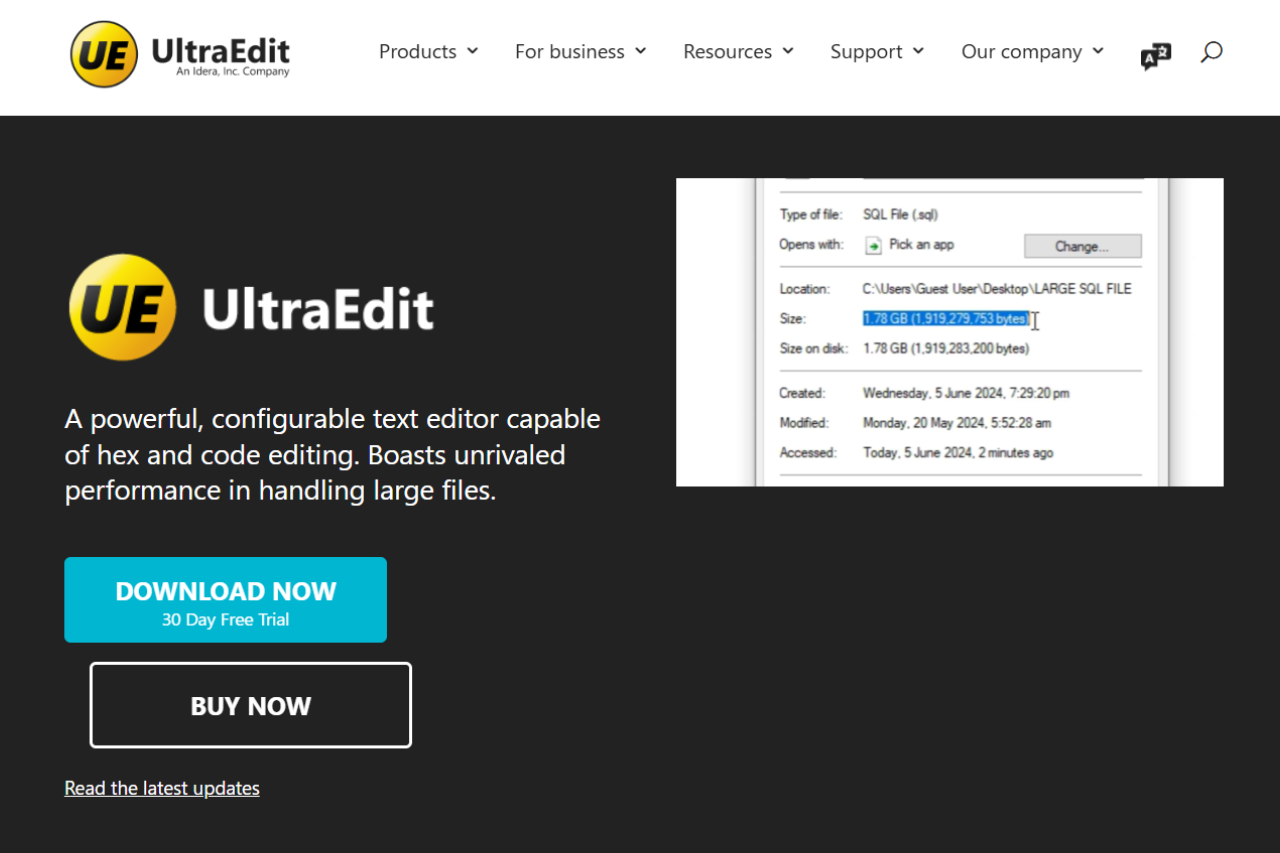
UltraEdit is a powerful and feature-rich text editor designed for professionals who need a robust, flexible tool for coding, text editing, and handling large files. With its rich set of features, UltraEdit is an ideal choice for developers, programmers, and data analysts. While its pricing may be a consideration for casual users, UltraEdit offers unparalleled customization, speed, and performance for users who work with complex or large-scale projects. Compared to other text editors like Notepad++, UltraEdit excels in providing advanced features like multi-caret editing, file comparison, and efficient handling of large files.
✅ Pros & ❌ Cons
Pros:
Large File Support: Handles files up to 4GB with ease, making it ideal for working with large text files and logs.
Highly Customizable: Offers a vast array of configuration options to tailor the editor to your needs.
Multi-caret and Multi-select Editing: Advanced editing features that increase productivity by allowing multiple selections and edits simultaneously.
Built-in FTP/SFTP Support: Supports remote file editing directly through FTP or SFTP, enabling efficient workflows for web developers.
Integrated Tools: Includes powerful tools for file comparison, regular expressions, macros, and more.
Cross-Platform Support: Available for both Windows and macOS, ensuring a wide range of compatibility.
Cons:
Pricing: UltraEdit is a paid software with a relatively high upfront cost, which may not be suitable for casual users.
Complexity: Due to its large number of features, new users may find it overwhelming to get started.
Not as Lightweight as Alternatives: The extensive features can make UltraEdit more resource-intensive compared to simpler editors like Notepad++.
No Free Version: Unlike Notepad++, UltraEdit does not offer a completely free version, which may deter some users.
📖 About
UltraEdit is a professional-grade text editor designed for high-performance editing, with support for large files, programming languages, and multiple encoding formats. It is particularly popular among developers, programmers, and data analysts due to its advanced features, such as multi-caret editing, file comparison tools, and built-in FTP/SFTP capabilities. UltraEdit offers a user-friendly interface while providing powerful tools for customization, making it an excellent choice for professionals who need efficiency and flexibility in their workflow.
🗓️ How It Works
Download and Install: Download UltraEdit from the official website and install it on your system (Windows or macOS).
Customize the Interface: Tailor the editor’s appearance and functionality to fit your workflow, choosing from themes, plugins, and configuration options.
Open a File: Start editing by opening a file, whether local or remote (via FTP/SFTP).
Utilize Advanced Features: Take advantage of powerful tools like multi-caret editing, file comparison, and built-in macros to enhance productivity.
Save and Share: Once your work is complete, save your file in various formats or upload it directly to remote servers using the integrated FTP functionality.
Users can specify the number of licenses, desired features, and any specific needs.
The request form helps UltraEdit provide a tailored quote based on your requirements.
This ensures you get the most appropriate and cost-effective solution for your text editing and development needs.
🥊 Competition
Feature
UltraEdit
Notepad++
Customization
Extensive customization options
Basic customization options
Large File Support
Handles files up to 4GB
Limited support for large files
Cross-Platform
Available on Windows and macOS
Available on Windows, with limited macOS support
FTP/SFTP Support
Built-in support for FTP/SFTP
No built-in FTP/SFTP support
Advanced Features
Multi-caret, file comparison, macros, etc.
Basic text editing features
Pricing
Paid (One-time fee)
Free
Learning Curve
Steep for beginners due to advanced features
More beginner-friendly
📌 Conclusion
UltraEdit is a powerful, feature-packed text editor that offers advanced functionality for professional users. While it may not be suitable for casual or beginner users due to its complexity and price, it excels in performance, customizability, and large file handling. If you work with large projects, codebases, or need advanced editing features, UltraEdit is a top-tier choice for enhancing your productivity.
UltraEdit: Empower Your Editing with Precision and Power
Mac-native alternative: UltraEdit is a cross-platform editor built for large files and power users. If you work only on macOS and want a lighter, native editor with snippets and the bundles system, TextMate is the elegant Mac option.
Atom is an open-source text editor designed to provide users with a fully customizable experience. Known as the “hackable text editor for the 21st century,” Atom shines with its modern, sleek interface, plugin support, and extensive flexibility. It is an excellent choice for developers and those who want an editor that can be tailored to their specific needs. Atom is ideal for users who prefer a powerful text editor with a user-friendly interface and a large collection of community-built packages. While it may not be as fast as some of its competitors in terms of performance, it offers unmatched customization options and plugin support.
✅ Pros & ❌ Cons
Pros:
Open-Source and Free: Atom is completely free to use, with no hidden fees or premium plans.
Highly Customizable: You can modify the editor’s appearance, themes, and functionality using plugins or by editing the code.
Large Package Ecosystem: Atom offers a vast collection of community-built plugins to extend its functionality.
Cross-Platform: Available for macOS, Windows, and Linux, making it accessible to a wide user base.
Smart Autocompletion: Offers smart autocompletion for code, making it easier to write and debug.
Built-In Git Support: Seamless Git integration for version control, allowing for easy commits and version tracking.
Cons:
Performance Issues: Atom can be slower compared to other editors, especially with large files or complex projects.
High Memory Usage: Due to its extensibility, Atom can consume more memory, making it less ideal for systems with limited resources.
Limited Support for Large Projects: It may struggle with performance when managing very large projects.
Not as Lightweight as Some Alternatives: Some users might prefer more minimalistic, faster editors.
Not Ideal for Heavy Development: While great for small to medium-sized projects, Atom is not as feature-rich for full-scale, enterprise-level development compared to other IDEs.
📖 About
Atom is an open-source text and source code editor developed by GitHub. It is designed for flexibility and customization, offering users the ability to install and create packages to add new features. Atom supports a variety of programming languages, including HTML, CSS, JavaScript, Python, and more. With its user-friendly interface and rich feature set, Atom is suitable for both beginner and experienced developers. While its performance can be affected by the number of installed packages, Atom’s highly configurable nature makes it a popular choice among developers.
🗓️ How It Works
Download and Install: Download Atom from the official website for free and install it on your system (available on macOS, Windows, and Linux).
Customize Your Editor: Once installed, you can begin customizing the editor’s look and functionality by adding packages and adjusting settings.
Install Plugins: Explore Atom’s vast package ecosystem to find plugins that enhance your coding experience.
Start Coding: Open a project or create a new file and start coding with features like syntax highlighting, smart autocompletion, and Git integration.
Use Git Features: Atom allows you to easily manage your projects with built-in Git support, so you can commit and push your code directly from the editor.
💲 Pricing Overview
GitHub offers a range of plans to cater to different user needs:
Free Plan: Ideal for individuals and organizations, this plan includes unlimited public and private repositories, 2,000 CI/CD minutes per month for public repositories, 500MB of Packages storage, and community support.
Team Plan: Priced at $4 per user/month, this plan includes all features of the Free plan, plus access to GitHub Codespaces, 3,000 CI/CD minutes per month for private repositories, 2GB of Packages storage, and advanced collaboration tools.
Enterprise Plan: At $21 per user/month, this plan offers all Team plan features, along with 50,000 CI/CD minutes per month for private repositories, 50GB of Packages storage, and enterprise-grade security and compliance features.
Additional add-ons are available:
GitHub Copilot: An AI-powered code completion tool, starting at $10/month after a 30-day trial. GitHub
GitHub Advanced Security: Provides advanced security features at $49 per active committer per month. GitHub
For detailed information and to compare features across plans, visit GitHub’s pricing page.
🥊 Competition
Feature
Atom
Visual Studio Code
Customization
Highly customizable with plugins and themes
Highly customizable with extensions
Performance
Can be slow with larger files and projects
Faster performance, especially with large files
Cross-Platform
Available on macOS, Windows, and Linux
Available on macOS, Windows, and Linux
Git Integration
Built-in Git support
Built-in Git support with advanced features
Package Ecosystem
Large community-driven package ecosystem
Vast marketplace for extensions and themes
Interface
Simple, user-friendly interface
More feature-rich, but with a steeper learning curve
Debugging
Basic debugging features
Advanced debugging features and tools
Free
Completely free and open-source
Free and open-source
📌 Conclusion
Atom is a versatile, open-source text editor perfect for developers who want an adaptable tool. While it may not offer the performance or full IDE features that some of its competitors like Visual Studio Code provide, its strong customization options, user-friendly interface, and robust package ecosystem make it an excellent choice for many. Atom excels in small to medium-sized projects and for developers who appreciate flexibility and personalization in their tools.
Atom shipped its last release in 2022. The closest cloud-IDE successor with full debugger and Lambda integration is covered in our AWS Cloud9 review.
Related read: Atom sold itself as the hackable editor, and GitHub retired it anyway. Komodo Edit made the same bet on a Mozilla base and community plugins and reached the same ending, so our Komodo Edit review is worth a look if you are working out which of these editors is still safe to install.
Papeeria is a browser-based LaTeX editor that runs document compilation in the cloud, so you can collaborate on a paper or thesis without installing TeX Live locally. It supports real-time co-editing, GitHub sync, BibTeX import, and PDF export, and runs in any modern browser. The free tier covers small public projects; paid plans unlock private collaborators and offline source export.
🏆 Our Verdict
Papeeria provides an excellent cloud-based LaTeX editor that simplifies the creation of complex academic documents. With its strong focus on user-friendly features and seamless real-time collaboration, Papeeria stands as a significant tool, particularly in the academic community. Compared to its competitors like Overleaf, it offers unique plotting tools and a straightforward user interface that may appeal to those who seek simplicity alongside comprehensive LaTeX support.
✅ Pros & ❌ Cons
Pros:
Real-Time Collaboration: Allows users to collaborate on documents in real time efficiently.
Plotting Tools: Integrated plotting tools which are not as common in other LaTeX editors.
Version Control: Efficient version control system helps keep track of changes and revert when necessary.
Affordable Pricing: More budget-friendly options compared to some leading competitors.
Cons:
Template Variety: Fewer templates compared to Overleaf, which can limit options for quick project setups.
User Base: Smaller community and user base, which might affect the variety and depth of community-driven templates and examples.
Integration with External Repositories: Limited integration capabilities with external repositories like GitHub compared to Overleaf.
📖 About
Papeeria is a robust LaTeX editor designed to facilitate the writing, collaboration, and publishing of scientific papers and academic documents. It supports real-time collaboration and offers a variety of tools to manage projects efficiently, making it suitable for both individual researchers and collaborative academic teams.
🗓️ How It Works
Sign Up: Users can quickly sign up for an account to start using the platform.
Create a Project: Start a new project with a choice of several templates or from scratch.
Invite Collaborators: Add collaborators to work simultaneously on the same project.
Edit and Compile: Utilize LaTeX editing and direct compiling features within the platform.
Publish: Export completed documents in various formats ready for publication or sharing.
💲 Pricing Overview
Epsilon Plan
Features:
Unlimited Public Projects and Templates: Create and use as many public projects and templates as you need.
Unlimited Collaborators: Invite as many collaborators as required for each project.
One Active Private Project: Manage one private project at a time. Additional projects can be archived to free up the active slot.
Archiving: Inactive projects can be archived to not count against your active private project quota.
Full-Text Search: Search capability restricted to current project files, helping you find necessary content quickly.
Git Sync: Full read-write access to public repositories, allowing efficient version control and collaboration.
File Edit History (New): Access the edit history of files covering the last 24 hours.
Simple Plot Builder: Basic tools for creating plots directly within the platform.
Delta Plan
Adds to Epsilon with:
Up to 10 Active Private Projects: Manage multiple private projects with the option to purchase more quota if needed.
Auto Compiling & Priority Compiling: Features that automatically compile your documents as you work, with prioritized processing speed.
Private Templates: Create and utilize custom templates for private use.
Full-Text Search Across All Projects: Enhanced search capabilities that extend across all projects you own or are joined in.
Git Sync with Private Repositories: Access and sync with private Git repositories.
File Edit History (New): Extended file edit history covering the last 30 days.
Synchronization with Dropbox and Google Drive (New): Seamlessly sync your documents and data with major cloud storage services.
Backup Snapshots: Regular backup snapshots to ensure data safety.
Integration with gnuplot and Mendeley: Advanced features ideal for students and researchers needing detailed data analysis and reference management.
Pricing:
Delta Plan: Starts at $5/month. Designed for individuals and small groups needing advanced features and multiple private projects.
Additional Information:
Free Forever for Students: The Delta plan is offered free forever to students, making it an ideal choice for those learning LaTeX and requiring robust features without financial burden.
Sign Up Options:
Users can sign up for either plan depending on their needs. The Epsilon plan offers basic features suitable for casual or beginning users, while the Delta plan provides comprehensive tools and enhancements for more intensive use.
These plans cater to a range of needs from basic document creation and collaboration to advanced project management and integration, making Papeeria a flexible option for LaTeX users.
🥊 Competition
Feature
Papeeria
Overleaf
Collaboration
Basic with all plans
Advanced with real-time tracking
Templates
Fewer, basic
Extensive, highly customizable
Plotting Tools
Included
Not available
User Interface
Simpler, easier to navigate
More complex with steep learning curve
Pricing
More affordable
Higher cost with more features
Community and Support
Smaller user community
Larger, more active community
📌 Conclusion
Papeeria offers a compelling option for those who need an efficient and straightforward LaTeX editor, particularly appealing to those in academia. While it may not boast the extensive template library or the vast community support of Overleaf, its unique features like integrated plotting and competitive pricing make it a worthy tool in the academic toolkit.
Papeeria: Perfecting Your LaTeX Projects with Precision
Papeeria has a permanent free tier with unlimited public projects, real-time collaboration on small teams, and BibTeX. Paid plans start around $4 per month for individuals and unlock private projects, larger uploads, and offline source export. There is no time-limited trial; the free tier is a hard floor, not an introductory offer.
How does Papeeria compare to Overleaf?
Papeeria and Overleaf occupy the same space of browser-based LaTeX collaboration with instant PDF preview. Overleaf has the larger template library and tighter integration with academic publishers like IEEE and Springer. Papeeria has GitHub sync built in and a more permissive free tier when you need private collaborators on small projects.
Does Papeeria work offline?
Papeeria needs an internet connection because the LaTeX engine compiles server-side. The source files can be exported on paid plans for offline editing in any text editor, and pushed back through GitHub sync when you reconnect. For a fully offline workflow, a local TeX Live install paired with VS Code remains the standard.
Related read: Papeeria is a cloud LaTeX workspace. If you would rather edit offline on your own machine, Texmaker is a free desktop editor with the same one-keystroke PDF build.
Related read: Papeeria runs LaTeX in the browser for shared projects. To write offline on your own machine with a zero-config setup, the TeXworks editor ships free with TeX Live.
Zettlr is an open-source markdown editor that excels in organization and accessibility for researchers, writers, and anyone who values structured note-taking. Its rich feature set and flexibility make it a strong competitor against alternatives like Obsidian. With its focus on academic writing and project management, Zettlr provides a unique solution for users who need a robust tool for handling markdown files and citations.
✅ Pros & ❌ Cons
Pros:
Open-Source: Freely available for anyone to use and customize.
Markdown Support: Offers extensive markdown capabilities, making formatting easy and efficient.
Citation Management: Integrates with reference managers like Zotero, facilitating academic writing.
Custom Workspaces: Allows users to organize notes into workspaces, enhancing productivity.
Cons:
Learning Curve: The vast array of features may be overwhelming for new users.
Limited Mobile Support: Primarily designed for desktop use, which may not be ideal for users needing mobile access.
Performance Issues: Some users report lagging with larger projects or extensive notes.
📖 About
Zettlr is designed for writers and researchers, providing a markdown editing environment that focuses on the needs of academic users. With features like citation integration, tagging, and a customizable interface, Zettlr aims to facilitate efficient note-taking and knowledge management. Its commitment to being open-source ensures that users can adapt it to their specific workflows.
🗓️ How It Works
Installation: Zettlr can be downloaded from its official website and installed on various operating systems.
Note Creation: Users can create and edit markdown notes with syntax highlighting and real-time preview.
Workspace Management: Users can organize notes into customizable workspaces for different projects.
Citation Management: Supports integration with citation managers to insert references into notes seamlessly.
💲 Pricing Overview
Zettlr is completely free to use, making it a cost-effective option for anyone looking for a powerful markdown editor without the need for subscriptions.
🥊 Competition
Feature
Zettlr
Obsidian
Open-Source
Yes
Yes
Markdown Support
Extensive
Extensive
Citation Management
Yes
No
Custom Workspaces
Yes
Yes
Mobile Support
Limited
Yes
Graph View
No
Yes
📌 Conclusion
Zettlr stands out as an excellent choice for researchers and writers looking for a comprehensive markdown editor. While it may have a learning curve and some limitations in mobile support, its robust features, including citation management and customizable workspaces, make it a valuable tool for knowledge management and academic work.
Zettlr: Your Comprehensive Markdown Solution for Academic Writing!
Related read: Zettlr is a Markdown editor aimed at researchers and academics. For a developer-focused take on the same Markdown-first, offline approach, Boostnote covers similar ground with code-block syntax highlighting built in.
Related read: Zettlr is a desktop Markdown editor built for long research writing. For a browser-based take on the same Markdown-first approach, with export and publishing handled online, see our StackEdit review.
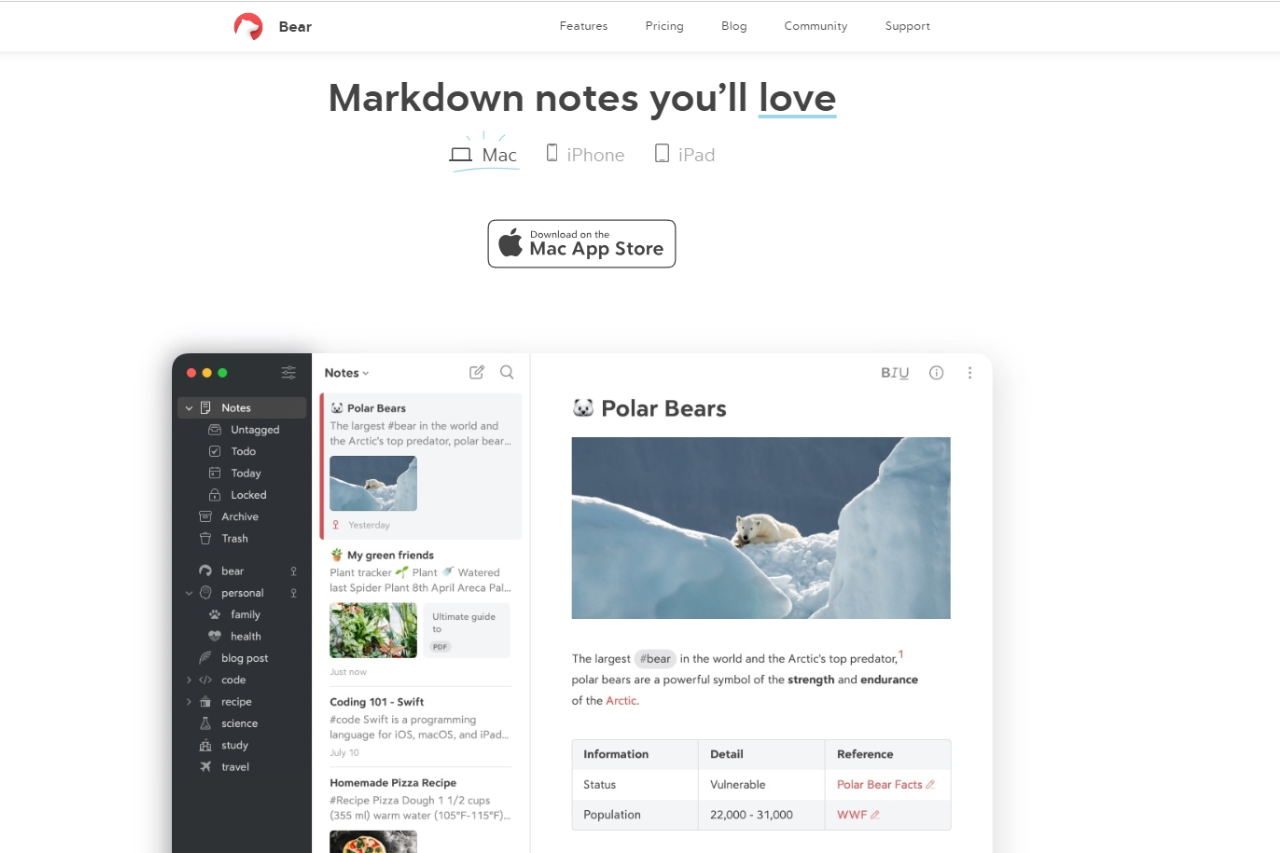
Bear is a beautifully designed, user-friendly note-taking app tailored for Apple devices. It combines simplicity with powerful features, making it an excellent choice for writers, students, and professionals alike. Its rich markdown support and seamless organization capabilities effectively position Bear as a competitor to apps like Notion.
✅ Pros & ❌ Cons
Pros:
User-Friendly Interface: Intuitive design makes it easy to navigate and use for taking notes.
Markdown Support: Allows users to format text effortlessly, enhancing the writing experience.
Tagging System: Organizes notes using hashtags, making retrieval simple and efficient.
Sync Across Devices: Syncs notes across iPhone, iPad, and Mac seamlessly through iCloud.
Cons:
Apple Ecosystem Only: Limited to iOS and macOS, which excludes Windows and Android users.
No Web Version: Lack of a web-based interface restricts accessibility from non-Apple devices.
Limited Free Version: The free version has restrictions, and users must subscribe to access all features.
📖 About
Bear is an open-source note-taking application developed specifically for the Apple ecosystem. It focuses on providing a distraction-free writing environment while supporting markdown formatting. Users can create notes, organize them with tags, and export them to various formats. Bear’s design and functionality have garnered positive reviews, especially for those heavily invested in Apple products.
🗓️ How It Works
Installation: Bear can be downloaded from the Mac App Store or the iOS App Store for free.
Note Creation: Users can create new notes quickly using a simple interface and start typing.
Markdown Formatting: Supports markdown syntax for formatting text, which can be used inline as users write.
Tagging and Organization: Notes can be tagged with hashtags for easy categorization and searching.
💲 Pricing Overview
Bear offers a straightforward pricing structure that ensures users have access to robust features while supporting further development of the app.
Free Version
Local Access to Your Notes: Store notes locally on your device without needing a subscription.
Document Scanning: Scan documents directly into the app for easy storage and reference.
Export Options: Export your notes to multiple formats including:
TXT
Markdown
TextBundle
RTF
PDF
JPG
HTML
DOCX
ePub
Customization: Access to 3 free themes and 1 app icon for personalization.
Search Functionality: Search within PDFs and images.
iCloud Sync: Sync your notes seamlessly with iCloud for access across your Apple devices.
This free version provides substantial value, particularly when compared to other note-taking apps for Mac, iPhone, and iPad, which often charge upwards of $80 per year for similar features.
Bear Pro
Bear Pro offers enhanced capabilities for users who need more from their note-taking app:
Price: A 7-day free trial is available, after which it costs:
$2.99 per month (or a discounted price of $29.99 per year when billed annually, saving you 15%).
Enhanced Features Include:
Local Access to Your Notes: Similar to the free version but with additional features.
Document Scanning: Ability to scan documents.
Export Options: Export your notes to the same formats as the free version, plus additional formatting options.
28+ Themes: A broader selection of themes for greater customization.
15 App Icons: More choices for personalizing your app icon.
Search Functionality: Enhanced search capabilities, including within PDFs and images.
iCloud Sync: Continued syncing of notes with iCloud.
Bear aims to provide a fair price for its Pro version to ensure regular updates and the ongoing development of the application, maintaining a balance between affordability and feature richness.
For more information about Bear and its pricing, you can visit the official website: Bear Pricing.
🥊 Competition
Feature
Bear
Notion
User-Friendly Interface
Yes
Yes
Markdown Support
Yes
Yes
Tagging System
Yes
Yes
Sync Across Devices
Yes (Apple only)
Yes (multi-platform)
Web Version
No
Yes
Pricing
Freemium
Freemium
📌 Conclusion
Bear is an outstanding choice for those within the Apple ecosystem looking for a clean, efficient, and powerful note-taking app. While it lacks a web version and is limited to Apple devices, its elegant design and rich feature set make it a valuable tool for writing and organization.
Bear: Your Elegant Solution for Organized Note-Taking!
Cross-platform alternative: Bear is Apple-only by design. If you work across Linux or Windows machines as well, Boost Note is the open-source option built for the same markdown-first workflow.
Eclipse is a highly versatile and powerful Integrated Development Environment (IDE) primarily geared towards Java development. With its extensive ecosystem of plugins and features, Eclipse is a strong competitor in the market, effectively challenging alternatives like IntelliJ IDEA. It is particularly favored by developers who value customization and flexibility in their development environment.
✅ Pros & ❌ Cons
Pros:
Open-Source Flexibility: Being open-source, Eclipse allows for extensive customization and a wide range of plugins.
Rich Plugin Ecosystem: Offers a vast selection of plugins that enhance functionality across various programming languages and frameworks.
Cross-Platform Compatibility: Available on Windows, macOS, and Linux, ensuring accessibility for all developers.
Integrated Tools: Provides built-in tools for debugging, version control, and testing, streamlining the development process.
Cons:
Steep Learning Curve: New users may find the interface and configuration options overwhelming compared to simpler IDEs.
Performance Issues: Can be resource-intensive, especially with multiple plugins installed, leading to slower performance.
User Interface: Some users feel the interface is less modern and intuitive compared to competitors like IntelliJ IDEA.
📖 About
Eclipse is an open-source IDE that primarily supports Java development but also accommodates a variety of programming languages through plugins. Originally developed by IBM, it has evolved into a robust platform with a strong community. Eclipse provides tools for coding, debugging, testing, and deploying applications, making it a comprehensive environment for software development.
🗓️ How It Works
Installation: Eclipse can be easily downloaded from its official website and installed on multiple platforms.
Workspace Setup: Users can create and manage multiple workspaces for different projects, allowing for organized project management.
Code Editing: The editor features syntax highlighting, code completion, and real-time error checking to enhance coding efficiency.
Plugin Management: Users can install and manage plugins from the Eclipse Marketplace to extend functionality based on their needs.
💲 Pricing Overview
Eclipse is completely free to use and open-source, providing a cost-effective solution for developers without the need for licensing fees.
🥊 Competition
Feature
Eclipse
IntelliJ IDEA
Open-Source
Yes
Community edition is free; Ultimate is paid
Plugin Ecosystem
Extensive
Extensive
Learning Curve
Steep
Gentler
Integrated Tools
Yes
Yes
User Interface
Functional but dated
Modern and intuitive
Performance
Can be resource-intensive
Generally better optimized
📌 Conclusion
Eclipse remains a solid choice for developers looking for a powerful and customizable IDE for Java and other programming languages. While it may not have the modern interface or performance optimizations of competitors like IntelliJ IDEA, its extensive features and open-source nature make it a valuable tool for many.
Eclipse: Your Versatile Partner in Java Development!
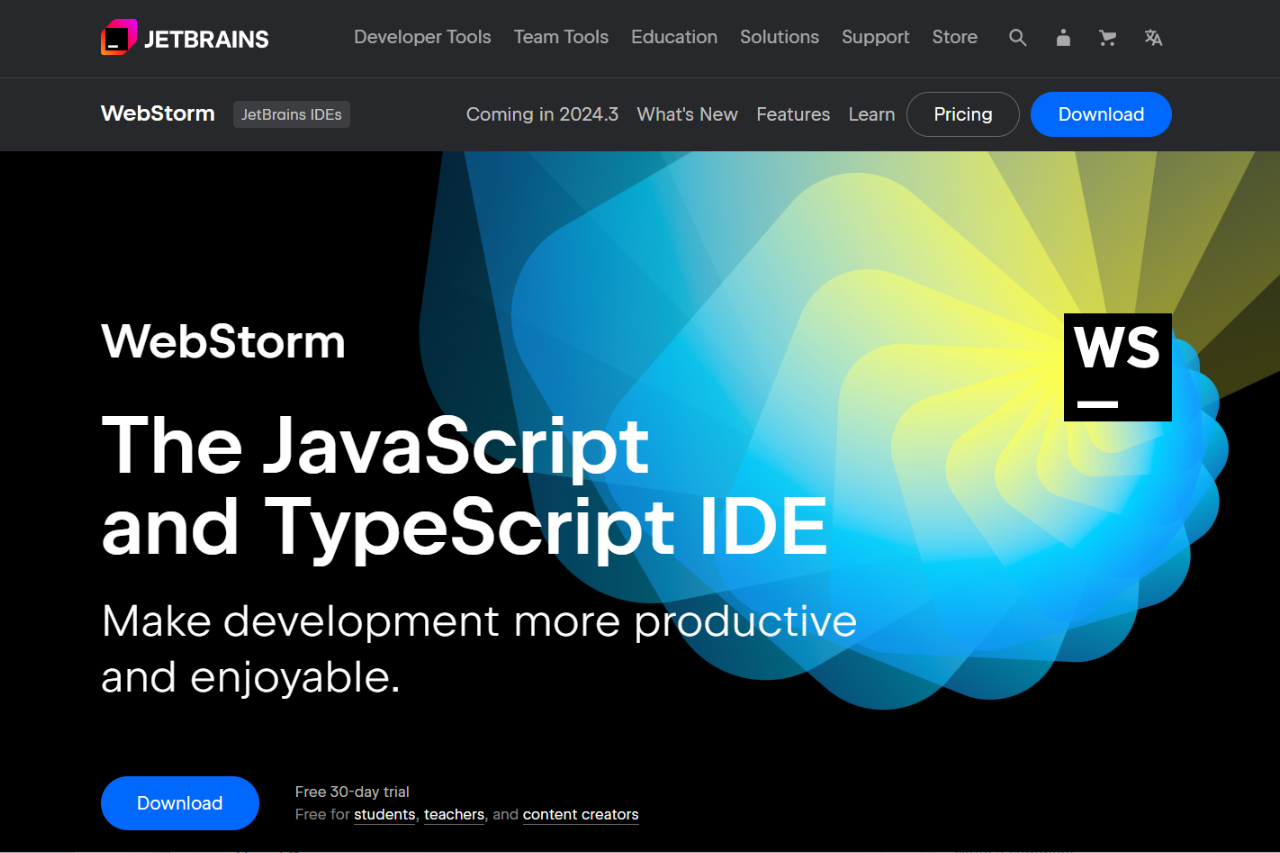
WebStorm is a highly robust and feature-rich Integrated Development Environment (IDE) specifically tailored for JavaScript, TypeScript, and related technologies. Its comprehensive set of tools and intelligent code assistance makes it a leading choice among developers, effectively competing with alternatives like Visual Studio Code. WebStorm’s focus on productivity and efficiency ensures a smooth coding experience, making it ideal for both individual developers and teams.
Integrated Debugging: Offers powerful debugging tools, allowing developers to test and troubleshoot applications seamlessly.
Version Control Support: Integrates well with version control systems like Git, simplifying collaboration.
Rich Ecosystem: Supports numerous frameworks and libraries, including React, Angular, and Node.js, enabling versatility in projects.
Cons:
Subscription Pricing: Requires a paid subscription, which may be a drawback for some users, especially those looking for free alternatives.
Resource Intensive: Can be heavy on system resources, potentially affecting performance on older machines.
Learning Curve: While user-friendly, the extensive features may take time to learn for new users.
📖 About
WebStorm is an IDE developed by JetBrains designed for JavaScript and related technologies. It provides comprehensive support for modern web development, including powerful tools for code editing, debugging, and testing. With features such as smart code completion, refactoring capabilities, and integration with various frameworks, WebStorm aims to streamline the development process and enhance developer productivity.
🗓️ How It Works
Installation: WebStorm can be downloaded and installed from the JetBrains website with ease.
Project Setup: Users can create or import projects and set up their development environment quickly.
Code Editing: Provides a rich editor with syntax highlighting, code completion, and linting, allowing for efficient coding.
Debugging and Testing: Integrated debugging tools help identify and fix issues quickly, with support for unit testing frameworks.
💲 Pricing Overview
WebStorm is available through a subscription model, with pricing options for individuals, businesses, and educational institutions. A free trial is available for new users to explore its features.
Standard Pricing:
First Year: $200.00 per user
Second Year: $159.00 per user
Third Year Onwards: $127.00 per user
All Products Pack (includes 12 IDEs, 3 extensions, 2 profilers):
First Year: $779.00 per user
Second Year: $623.00 per user
Third Year Onwards: $467.00 per user
Additional Options
The prices may vary based on whether you opt for features like JetBrains AI Pro, which can enhance the functionality of WebStorm.
These variations in pricing can lead to different amounts being quoted depending on the specific package or option you are looking at. It’s always a good idea to check the latest prices on the official JetBrains website for the most accurate and current information: WebStorm Pricing
🥊 Competition
Feature
WebStorm
Visual Studio Code
Intelligent Code Assistance
Yes
Yes
Integrated Debugging
Yes
Yes
Version Control Support
Yes
Yes
Pricing
Subscription
Free
Resource Usage
High
Moderate
Customizability
Moderate
High
📌 Conclusion
WebStorm is an exceptional choice for developers focused on JavaScript and web development. While it may come with a subscription cost and require some time to master, its robust features and integrated tools make it a valuable asset for any development team.
WebStorm: Your All-in-One IDE for Efficient JavaScript Development!
Bluefish is a fast and powerful open-source editor that excels in web development, offering a rich feature set while maintaining a lightweight footprint. Its user-friendly interface and support for multiple programming languages make it a strong competitor in the market, effectively challenging alternatives like Visual Studio Code. Ideal for developers seeking a focused environment for coding, Bluefish provides tools that enhance productivity without unnecessary complexity.
✅ Pros & ❌ Cons
Pros:
Lightweight and Fast: Designed for speed and efficiency, making it ideal for quick edits and large projects.
Multi-Platform Support: Runs on Windows, macOS, and Linux, ensuring accessibility for a wide range of users.
Syntax Highlighting: Supports numerous programming languages with syntax highlighting, improving code readability.
Powerful Search and Replace: Features advanced search and replace capabilities that streamline the editing process.
Cons:
Limited IDE Features: Lacks some advanced features found in more comprehensive IDEs, like integrated debugging.
Less Frequent Updates: Development updates are not as frequent as some competitors, which may affect new feature availability.
User Interface: The interface may feel outdated compared to modern editors, which could impact user experience.
📖 About
Bluefish is an open-source text editor primarily designed for web development. It provides a lightweight yet powerful platform for editing HTML, CSS, JavaScript, and other programming languages. With features like code folding, syntax highlighting, and an easy-to-navigate interface, Bluefish aims to support developers in their workflow while maintaining simplicity and speed.
🗓️ How It Works
Installation: Bluefish can be easily downloaded and installed on various operating systems from its official website.
Code Editing: Users can write and edit code with real-time syntax highlighting and code folding, enhancing clarity and organization.
Project Management: Bluefish allows users to manage multiple projects efficiently, facilitating easy navigation between files.
Customizable Interface: Users can adjust the interface and toolbars to fit their individual preferences, making for a personalized coding experience.
💲 Pricing Overview
Bluefish is completely free to use, providing an open-source solution for developers without any licensing fees.
🥊 Competition
Feature
Bluefish
Visual Studio Code
Lightweight
Yes
No (can be resource-heavy)
Multi-Platform Support
Yes
Yes
Syntax Highlighting
Yes
Yes
Integrated Debugging
No
Yes
Customizability
Basic
Extensive
User Interface
Simple but outdated
Modern and intuitive
📌 Conclusion
Bluefish is an excellent choice for web developers looking for a fast, lightweight editor that doesn’t compromise on features. While it may not offer the comprehensive capabilities of competitors like Visual Studio Code, its speed and simplicity make it a valuable tool for many coding tasks. Bluefish is built around web development. For general programming in another lightweight tool, see our review of Geany, a small IDE that can compile and run your code.
Bluefish: Your Efficient Partner for Rapid Web Development!
Emacs is a highly powerful and extensible text editor that caters to both novice and advanced users. With its extensive capabilities and customization options, it remains a formidable competitor in the market, effectively challenging alternatives like Visual Studio Code. Emacs is especially favored by those who appreciate its keyboard-centric operation and its ability to be tailored for a wide range of tasks beyond just text editing.
✅ Pros & ❌ Cons
Pros:
Extensible and Customizable: Users can tailor Emacs to fit their specific needs through extensive configuration and numerous packages.
Powerful Scripting Language: Built-in Emacs Lisp allows for advanced scripting and automation of tasks.
Multi-Functional: Functions as a text editor, IDE, email client, calendar, and more, all within one platform.
Cross-Platform: Available on various operating systems, including Windows, macOS, and Linux.
Cons:
Steep Learning Curve: New users may find the interface and commands overwhelming compared to more intuitive editors.
Resource Intensive: Can be heavy on system resources, especially when loaded with many packages.
Complex Setup: Initial setup and configuration may be daunting for users who prefer straightforward tools.
📖 About
Emacs is an open-source text editor known for its versatility and extensibility. Originally developed in the 1970s, it has evolved into a robust platform for programming, writing, and productivity. Emacs supports various programming languages and provides an extensive library of packages to enhance functionality. Its user interface is keyboard-driven, making it appealing to those who prefer to minimize mouse usage.
🗓️ How It Works
Installation: Emacs can be downloaded and installed from its official website for various platforms.
Editing Capabilities: Users can create and edit text files with syntax highlighting, auto-completion, and powerful search features.
Customization: Configuration files (.emacs or init.el) allow users to set preferences and load packages for added functionality.
Package Management: Users can install packages to extend Emacs’ capabilities, covering everything from programming languages to project management.
💲 Pricing Overview
Emacs is completely free to use and open-source, making it a cost-effective solution for anyone looking for a powerful text editing environment.
🥊 Competition
Feature
Emacs
Visual Studio Code
Extensibility
Yes
Yes
Multi-Functional
Yes
Limited
Learning Curve
Steep
Gentle
Custom Scripting
Emacs Lisp
JavaScript and TypeScript
Cross-Platform Support
Yes
Yes
Integrated Debugger
Limited
Yes
📌 Conclusion
Emacs stands out as a powerful text editor for users who value customization and versatility. While its steep learning curve may deter some, its extensive capabilities and active community make it a valuable tool for anyone looking to enhance their productivity.
Emacs: Your Ultimate Editor for Customizable and Efficient Text Editing!
TextMate is a versatile text editor that blends simplicity and power, designed specifically for macOS users. Its intuitive interface and robust feature set make it a strong competitor in the market, particularly for developers who appreciate customization and efficient workflow. While it faces competition from popular alternatives like Sublime Text, TextMate’s unique capabilities and macOS integration provide a compelling option for many users.
✅ Pros & ❌ Cons
Pros:
MacOS Integration: Seamlessly integrates with macOS features, enhancing user experience.
Customizable Snippets: Users can create and manage snippets to speed up coding tasks.
Extensible with Bundles: Supports bundles that add functionality and syntax highlighting for various languages.
Lightweight: Fast and efficient, making it suitable for quick edits and larger projects.
Cons:
Limited Cross-Platform Support: Primarily designed for macOS, which may alienate Windows or Linux users.
Learning Curve: The extensive customization options can be overwhelming for new users.
Fewer Features than IDEs: Lacks some advanced features found in full-fledged IDEs like Sublime Text.
📖 About
TextMate is an open-source text editor created for macOS, focusing on simplicity and versatility. It supports a wide range of programming languages and offers features such as customizable snippets, code folding, and a robust bundle system. TextMate is particularly favored by developers who work on web applications and need a fast, efficient editor that integrates well with the macOS environment.
🗓️ How It Works
Installation: TextMate can be easily downloaded from its official website and installed on macOS.
Code Editing: Users can write code with syntax highlighting and automatic indentation, improving readability.
Custom Snippets: The snippet management feature allows users to create reusable code blocks to enhance productivity.
Bundle Management: Users can install and manage bundles to extend functionality and support for various programming languages.
💲 Pricing Overview
TextMate is free to use and open-source, making it an accessible choice for developers without the need for expensive licenses.
🥊 Competition
Feature
TextMate
Sublime Text
MacOS Integration
Yes
No
Custom Snippets
Yes
Yes
Extensible with Bundles
Yes
Yes
Lightweight
Yes
No (can be resource-heavy)
Cross-Platform Support
No
Yes
📌 Conclusion
TextMate is an excellent choice for macOS users looking for a powerful yet lightweight text editor. While it may not have all the advanced features of competitors like Sublime Text, its ease of use and customization options make it a valuable tool for developers.
TextMate: Your Elegant Solution for Efficient Text Editing on macOS!
TextMate is free, open source, and still runs on current macOS, but active development slowed years ago and new releases are rare. As a fast, native editor that opens instantly and stays out of the way, it holds up. Treat it as stable and mature rather than actively evolving.
Who it suits
Writers and developers who want a lightweight macOS editor with snippets, macros, and the bundles system for language support. If your day is mostly quick edits, config files, and small scripts, TextMate is still pleasant to live in. Anyone who needs a large plugin ecosystem, live collaboration, or the same experience on Windows and Linux will feel the gaps.
The closest alternatives
On macOS, BBEdit is the maintained heavyweight and Nova is the modern Panic option. Sublime Text is the fast cross-platform pick, and Visual Studio Code covers the rest with the largest extension library. Move when you need active updates or a feature TextMate no longer ships. Stay if a calm, native editor is all you want.
TextMate vs BBEdit vs Sublime Text vs Nova
TextMate is a long-standing Mac editor, but it is not the only option for macOS. Here is how it compares with three editors people weigh against it, on the points that usually decide the pick: price, how native it feels on the Mac, and the work it suits best.
Choose TextMate when you want a free, native Mac editor that stays out of the way. Reach for BBEdit on very large files, Sublime Text when you want speed and plugins across platforms, and Nova when you want a modern Mac app with web tooling baked in.
Troubleshooting TextMate: four problems and what actually fixes them
TextMate is a small app that expects to live inside a shell workflow, and almost every problem people hit is at that seam rather than in the editor. All four fixes below are documented by MacroMates, so none of them needs a plugin.
The mate command is not found in Terminal
TextMate ships its own command line tool, but it is not installed with the app. Open Preferences, go to the Terminal page and install it from there, then run mate with the help flag to confirm you get a version number back. After that, mate followed by a dot opens the current folder as a project, which is the fastest way into a repository you are already standing in. If you are editing a file you do not own, run mate under sudo rather than saving and answering the admin prompt: TextMate accepts the authorization the shell already has, and your password stays cached for the next file instead of being tied to the one document.
Git commits before you have finished writing the message
Commands that hand off to an editor expect it to block until you are done. TextMate returns immediately unless you tell it to wait, so setting EDITOR to mate on its own makes Git commit an empty message and makes any other tool that shells out behave the same way. Add the wait flag in your profile and both stop. Crontab is the exception, because it does not accept arguments in that variable at all: create a symbolic link to mate whose name ends in underscore wait, and point EDITOR at the link. TextMate reads the suffix and waits.
Your commit message opens with the cursor halfway down the file
This looks like a bug and is a side effect of a feature. Git reuses one file for every commit message in a repository, and TextMate restores the cursor to wherever you left it, reading that position from the file’s extended attributes. Current versions no longer write those attributes for commit messages, but they still read the ones an older version left behind, so old repositories keep doing it. Set the Git editor, either through the environment variable or through the core.editor setting, to mate with the wait flag and line one. That pins the cursor to the top without your having to strip the attributes by hand.
TextMate asks you to pick an encoding every time you open a file
It only asks after four checks have all failed. It looks for a byte order mark, then for a com.apple.TextEncoding extended attribute, then for an encoding setting in a .tm_properties file, then it tests whether the content is valid ASCII or UTF-8. A legacy file in a regional encoding fails all four. The fix is the third check: put a .tm_properties file at the top of the project and declare the encoding once, and every file under it opens without a prompt. Do not reach for a UTF-8 byte order mark to silence the dialog. It works, and MacroMates says plainly in the same paragraph that it is not the right answer.
Setting up a TextMate project, step by step
TextMate treats any folder you open as a project. Open Quickly, Find in Project and most bundle commands then work on that folder. The five steps below set one up so that search stays fast and version control works from the first commit. Each step follows the TextMate 2 manual from MacroMates.
Open the folder, not a file. Use File, Open, or drag the folder onto the TextMate icon in the Dock. The window title then shows the folder name and, in a Git repository, the current branch. If a command seems to act on the wrong files, press Shift-Command-P to see which folder TextMate uses as the project folder.
Install the bundles for your languages. Open Preferences and go to the Bundles page. Tick the languages and tools you work with. Bundles hold the grammars, snippets and commands for each language, so a missing bundle is the usual reason a file shows no syntax colors.
Add a .tm_properties file at the project root. Most projects have folders you never edit, such as vendor code, caches and logs. These two lines keep them out of Open Quickly and Find in Project, and the file browser still shows them:
Put the file at the top level. Both searches read the settings of the folder they start from, and they ignore a .tm_properties file in a subfolder.
Move around with Open Quickly and Find in Project. Command-T opens any file in the project by name. Shift-Command-F searches every file. To narrow a single search, type a glob in the matching field of the Find dialog: ~logs/** skips the logs folder and leaves your settings alone.
Commit from the file browser. TextMate detects Git, Mercurial, Subversion and Perforce, and it puts a status badge on each changed file. Shift-Command-Y lists modified and untracked files. The SCM commands act on the file browser selection. Press Shift-Command-A to clear the selection before you commit the whole project, or Control-Command-R to select only the document you are editing.
This website uses cookies to ensure you get the best experience on our website. Surfing the website you are authorizing the use of cookies.
Privacy & Cookies Policy
Privacy Overview
This website uses cookies to improve your experience while you navigate through the website. Out of these cookies, the cookies that are categorized as necessary are stored on your browser as they are essential for the working of basic functionalities of the website. We also use third-party cookies that help us analyze and understand how you use this website. These cookies will be stored in your browser only with your consent. You also have the option to opt-out of these cookies. But opting out of some of these cookies may have an effect on your browsing experience.
Necessary cookies are absolutely essential for the website to function properly. This category only includes cookies that ensures basic functionalities and security features of the website. These cookies do not store any personal information.
Any cookies that may not be particularly necessary for the website to function and is used specifically to collect user personal data via analytics, ads, other embedded contents are termed as non-necessary cookies. It is mandatory to procure user consent prior to running these cookies on your website.